
Art Poster: Wall Design with Intention and Format
An art poster is more than decoration — it is a considered design decision. Which motif suits the mood of a room? Which format and paper make the difference? This page offers practical guidance: factual, without exclamation marks.
What Sets an Art Poster Apart from a Simple Print
The term art poster describes printed wall pieces that go beyond pure decoration in terms of design. That might be an abstract screen print, a large-format photographic work, or a typographic composition — what matters is that the motif and its execution are aligned. Quality does not come from an appealing subject alone, but from the combination of printing method, paper weight, and surface finish.
Good art posters are printed on papers from 200 g/m² upwards, often with a matte coating that minimises reflections and brings out colour depth evenly. FSC-certified papers are not only a marker of quality but also an indicator of responsible supply chains. Reetro uses exclusively these materials and has all formats printed to order by our production partner in the EU — this has a direct effect on colour stability and sharpness.
When buying a motif online, sample prints are rarely available. That makes it all the more important to check the technical specifications: resolution, colour profile, and paper type provide more reliable guidance than descriptive copy. An art poster intended for living spaces should resolve at a minimum of 300 dpi and be designed for the light conditions of the intended room.
Art Poster Formats and Substrates at a Glance
Art posters are available in a range of formats and on different substrates. The choice depends on the room concept, the wall area, and the desired character of the image.
Paper Print (Poster)
The classic art poster on matte paper from 200 g/m² — easy to swap, frameable, and available in almost any format. Matte surfaces reduce light reflections and are particularly well suited to bright rooms.
Premium Canvas
Canvas stretched over a wooden frame gives the motif a three-dimensional presence. Its textured surface breaks light differently from paper and creates a painterly quality — even with photographic subjects.
Aluminium Wall Art (Hexagon)
Direct printing on aluminium Dibond yields a smooth, resilient surface with exceptional colour reproduction. Reetro's hexagon format allows unconventional wall arrangements without standard frames.
XXL Poster
From 100 cm width upwards, art posters develop a presence of their own in a room. XXL formats suit generous walls in living rooms, offices, or hallways — provided the resolution and print quality keep pace with the format.
Style and Motif: How an Art Poster Fits a Room
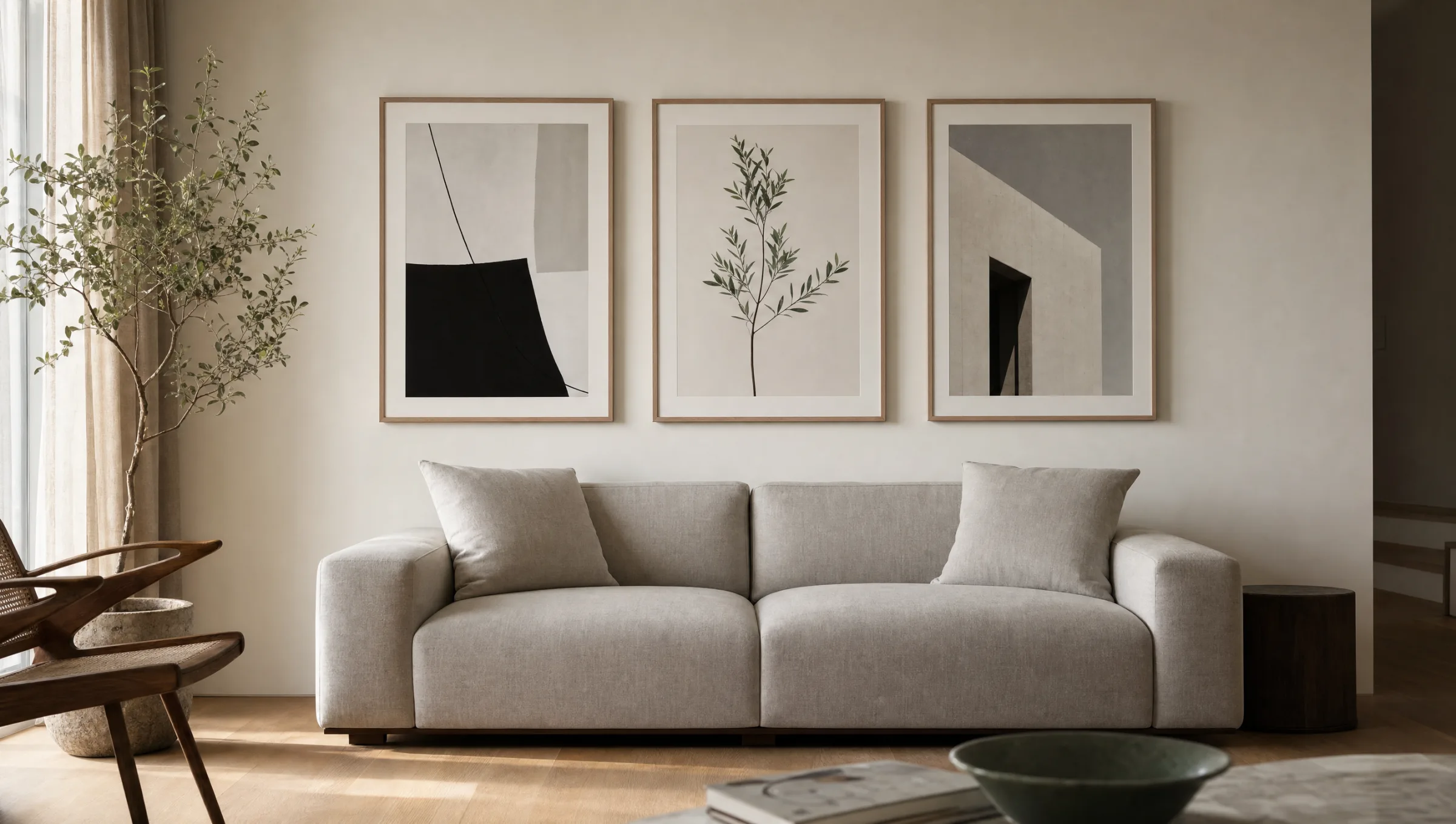
The question of which art poster belongs in a given room cannot be answered with universal rules. There are, however, practical reference points: calm, tonal motifs — such as monochrome botanicals or reduced architectural photography — have a balancing effect in rooms with many surfaces and patterns. High-contrast, linear works function well on neutral, light-coloured walls.
The relationship between poster format and furniture also matters. An art poster hung above a sofa should not be narrower than two-thirds of the seating width, so that the proportions feel balanced. When hanging at eye level, placing the centre of the image at approximately 145–160 cm is a reliable guide — a convention from museum practice that works equally well in the home.
Gallery walls composed of several art posters follow their own rules of composition. Matching frame colours and a consistent gap of 5–10 cm between pieces create visual calm without suppressing the variety of motifs. Mixed formats work when a dominant centrepiece is established, around which smaller works are grouped.
A well-chosen art poster needs no explanation — it orders a room without commenting on it.
Reetro Editorial
Care and Hanging: Preserving the Longevity of an Art Poster
Art posters on paper are more sensitive to light than canvas or aluminium prints. Direct sunlight accelerates colour fading — particularly for unglazed works. Behind UV-protective glass or in shaded areas of the wall, colour intensity remains stable for considerably longer. For damp rooms such as bathrooms, paper prints are less suitable; aluminium wall art is a better option here.
For heavier formats from 50×70 cm upwards, a picture hook with a wall plug is recommended over simple adhesive strips. For temporary arrangements or rented properties, strong adhesive hooks with pull-tab removal are a workable alternative, as long as the permissible load is not exceeded. Reetro posters in A2 format on 200 g/m² paper weigh less than 200 g — lightweight hanging solutions are generally sufficient.
Art Poster as a Gift: What to Consider
An art poster works as a gift when the motif suits the recipient, not your own taste. Botanical illustrations, city views, abstract colour fields, and animal portraits are genres with broad appeal that do not feel generic. The choice of format should be realistic: an A1 poster only makes sense if the recipient actually has a suitable wall to hang it on.
Many retailers — including Reetro — offer prints in several formats for the same motif, which makes it easier to tailor the gift. It is also worth looking at designer cushions with coordinating motifs: smaller gifts with a consistent visual language often feel more considered than a single large print.
Häufige Fragen
-
01
What makes a high-quality art poster?
A high-quality art poster is defined by three factors: print resolution (at least 300 dpi), paper weight (from 200 g/m² upwards), and surface finish. Matte coatings reduce reflections and make colour nuances more evenly visible. The printing method also plays a role — giclée printing and high-resolution inkjet achieve the most detailed results. The colour profile of the motif should be optimised for the print colour space (CMYK), so that the printed art poster stays as close as possible to the digital original.
-
02
What format should an art poster be for a living room?
In living rooms, formats between 50×70 cm and 70×100 cm have proven well-proportioned and versatile. When hanging above a sofa, a useful rule of thumb is that the poster width should be at least two-thirds of the width of the furniture. For freestanding walls without reference furniture, XXL formats from 100 cm width can be used, provided the wall area supports it. Formats that are too small against large walls tend to look lost, even if the motif itself is strong.
-
03
How do I hang an art poster correctly?
The centre of the image should hang at approximately 145 to 160 cm — this corresponds to average eye level and is standard practice in gallery spaces. For posters from 50×70 cm upwards, a wall hook with a plug is recommended. In rented properties, adhesive hooks with pull-tab removal are an alternative, provided the poster weight stays within the hook's load capacity. Paper formats up to A2 at 200 g/m² rarely weigh more than 200 g and can be safely fixed with lightweight hanging systems.
-
04
Is an art poster suitable for damp rooms?
Paper-based art posters are sensitive to sustained moisture — warping, colour shift, and paper buckling are possible consequences in bathrooms or kitchens. For such spaces, aluminium Dibond prints or directly coated photo prints are more appropriate, as these materials are water-resistant and dimensionally stable. If a paper print is nonetheless preferred for a damp room, it should be secured behind glass in a tightly sealed frame, with adequate ventilation in the room.
-
05
How do art posters and canvas prints differ in terms of design?
An art poster on paper appears flatter and sharper in detail — the smooth surface reproduces fine lines and contrast with precision. A canvas print, by contrast, breaks light slightly through its woven texture, lending photographic and painterly subjects a material depth. The choice depends on the motif and the desired impression: paper prints are often the better fit for photography and typography, while canvas suits painted and organic subjects.
-
06
Where are Reetro art posters printed, and what materials are used?
Reetro has all posters and wall art printed to order by our production partner in the EU. Paper prints use FSC-certified papers from 200 g/m² with a matte coating. Canvas prints are mounted on cotton-polyester fabric and stretched over sturdy wooden frames. Aluminium Dibond wall art uses a lightweight composite aluminium material with a direct print surface. Each piece is printed to order close to the customer, in the EU or the US, so delivery routes stay short and print quality stays consistent.