
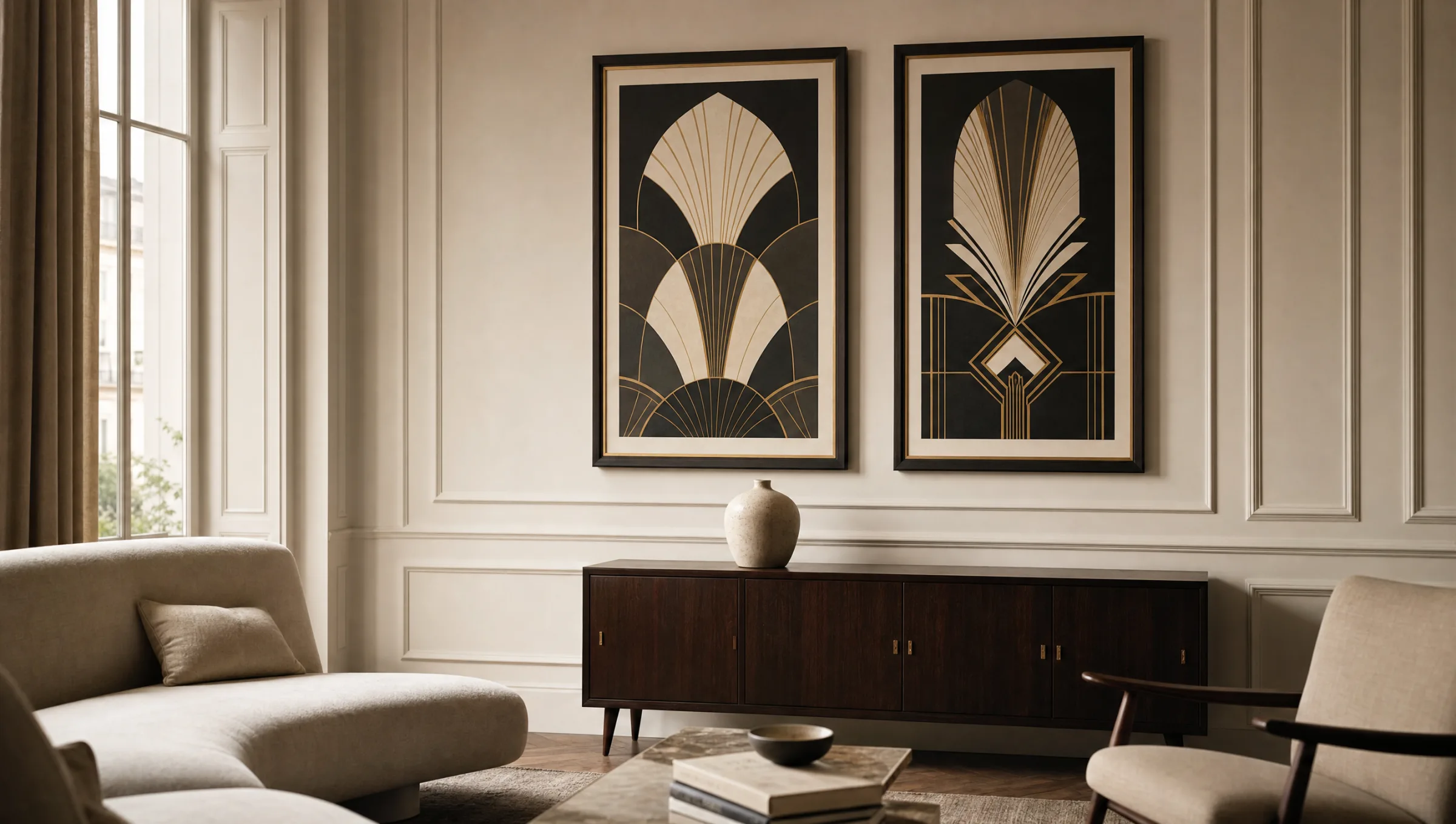
Art Deco Prints – Geometric Elegance as Wall Art
Art deco prints combine strict geometry, luxurious colour palettes and a decorative clarity that has lost none of its presence a hundred years on. As a poster or canvas print, they bring a quiet, architectural strength to any room — without demanding the space rearrange itself around them.
What Makes Art Deco Prints So Timeless?
The Art Déco style emerged in the 1920s and 1930s as a counterpoint to the ornament-heavy Art Nouveau movement. It favoured symmetrical forms, clean lines and a deliberate reduction to the essential — while never quite abandoning opulence. Characteristic elements include fan motifs, concentric arches, sunburst patterns and the use of gold, black, cream and saturated single colours such as emerald green or cobalt blue.
Art deco prints carry that visual language into the contemporary interior. They work equally well in a classically furnished period flat and a modern, minimalist home, because their geometry can enter into dialogue with both. Print quality is decisive: fine lines and gold tones read far more precisely on heavy, matte-coated paper than on inexpensive high-gloss stock.
Unlike purely decorative patterned wallpaper, a well-chosen Art Déco motif always carries a compositional statement. There is a centre, a hierarchy of forms, a considered distribution of visual weight — and that is what makes art deco prints genuine wall art rather than background decoration.
Three Formats for Art Deco Prints at a Glance
The choice of format shapes how geometric motifs read in a room. These three options suit classic Art Déco subjects most consistently.
Portrait Poster (50×70 cm, 61×91 cm)
Vertical compositions — such as stylised female figures, fan motifs or tower forms — unfold most powerfully in portrait orientation. Ideal as a single piece above a sideboard or as a symmetrical pair flanking a mirror.
XXL Canvas (100×150 cm and larger)
Large-format canvas prints deploy Art Déco patterns as a room-defining element. Geometric all-over patterns in particular benefit from the additional surface: the repetition of forms only becomes fully legible beyond a certain scale.
Hexagonal Aluminium Wall Panels
Hexagonal panels in brushed aluminium complement Art Déco's formal language on a material level. The six-sided support echoes the geometric motifs, while the metal substrate introduces a subtle sense of depth.
How to Combine and Place Art Deco Prints
When grouping several art deco prints into a gallery wall, a coherent colour palette is essential. Three to five pieces sharing a common tone — gold, black and cream, for instance — read as more considered than a mix of unrelated colour schemes. Framing in black or matte gold reinforces the period without tipping into pastiche.
In rooms with high ceilings, a vertical arrangement of two or three prints stacked above one another can emphasise the height of the space. In lower-ceilinged rooms, a horizontal run of prints at eye level works better. Art deco prints also hold their own as a single, dominant statement piece — especially when the surrounding furniture is kept deliberately restrained.
Materiality plays an underestimated role. Matte paper surfaces from 200 g/m² upward absorb scattered light and allow lines to appear sharper. Gloss finishes, by contrast, can blur contours under certain lighting conditions and distort gold tones. For Art Déco motifs, a matte or satin-matte coating is therefore usually the stronger choice.
Art Déco is not nostalgia — it is a design language that unites order and sensuality within a single pattern. That is what makes it so useful for the contemporary home.
Reetro Editorial
Care and Longevity of Art Deco Prints
Prints on FSC-certified paper with UV-stable inks are significantly more lightfast than those produced on standard stock. This matters particularly for art deco prints, since gold tones and deep blacks are sensitive to fading. Positioning away from direct sunlight extends their lifespan considerably.
For unframed posters, a dry microfibre cloth drawn lightly across the surface is sufficient for cleaning. Framed prints behind glass need only an occasional wipe of a slightly damp cloth on the frame itself. Canvas prints can be cleaned with a lightly dampened cloth, provided no solvent-based cleaners are used.
Häufige Fragen
-
01
What are typical subjects in art deco prints?
Typical subjects in art deco prints include geometric fan shapes, sunburst and zigzag patterns, stylised female figures, 1920s city skylines and floral elements rendered in strict geometric form. Black-and-gold contrasts, cream and ivory tones, and single saturated colours such as emerald green or cobalt blue tend to dominate. Motifs are invariably symmetrical or at least strongly structured in their composition.
-
02
Which framing suits art deco prints best?
Narrow frames in matte black or brushed gold harmonise most naturally with art deco prints, echoing the style's formal language without overwhelming the motif. Silver and chrome frames can also work but read as somewhat more contemporary. For a clean, uncluttered look, a simple black frame with a white mount gives even smaller formats more visual presence on the wall.
-
03
How large should art deco prints be for a living room?
For an average living room with three to four metres of wall width, formats from 50×70 cm upward are advisable, so that the fine lines and geometric details of Art Déco motifs remain legible at a distance. On a sofa wall as the main focal point, XXL formats from 100×140 cm work well as a single statement piece. Smaller formats such as 30×40 cm are well suited to gallery walls combining several prints.
-
04
Can art deco prints work alongside modern interior design?
Yes, art deco prints integrate well into modern, minimalist spaces. The clear line work and deliberate reduction of the motifs share a formal kinship with modernism. What matters is that the surrounding interior is not too busy: smooth surfaces, little decorative clutter and neutral wall colours allow the geometric motifs to stand freely, so the stylistic contrast reads as intentional rather than jarring.
-
05
What paper is best for art deco prints?
Matte or satin-matte papers weighing at least 200 g/m² are the recommended choice for art deco prints, as these surfaces render lines more crisply and gold tones more faithfully than high-gloss stock. Reetro has its posters printed to order by its production partner in the EU on FSC-certified paper with UV-stable inks — keeping blacks deep and gold tones colour-accurate over time, even without framing behind glass.