Unusual Wall Art: Subjects Beyond the Expected
Unusual wall art draws its strength from the tension between subject, material and space. We look at how unconventional motifs, unexpected formats and considered print techniques work together — and what matters most when a piece is meant to move beyond decorative ordinariness without becoming overbearing.
What makes unusual wall art distinctive
A piece of wall art is not unusual simply because it is loud. On the contrary, many of the most interesting works appear calm at first glance and reveal their character only on closer inspection. What matters is the break with expectation — whether in the subject, the crop, the reduction of colour or the format. A classic portrait in an extreme tall format can feel just as unconventional as a botanical study printed in sharp black and white rather than naturalistic tones.
Anyone searching for unusual wall art should therefore ask less about effects and more about attitude. Which visual language suits the room, and what story should the wall tell? A single, strongly individual motif often contributes more than a wall full of decorative prints that cancel each other out.
Material questions also play a role. Matte fine paper, brushed aluminium or a canvas with visible texture all change the same motif considerably. A print does not become unusual wall art automatically through its substrate, but it gains an additional layer that sets it apart from an interchangeable poster print.
Four directions for unusual wall art
The following categories bring together subject areas that work beyond typical living-room prints and sit well alongside restrained, minimal interiors.
Surreal Collages
Assembled image worlds built from architectural fragments, plants or everyday objects. They play with scale and logic, and work especially well in rooms that are otherwise very functional in character.
Abstract Colour Fields
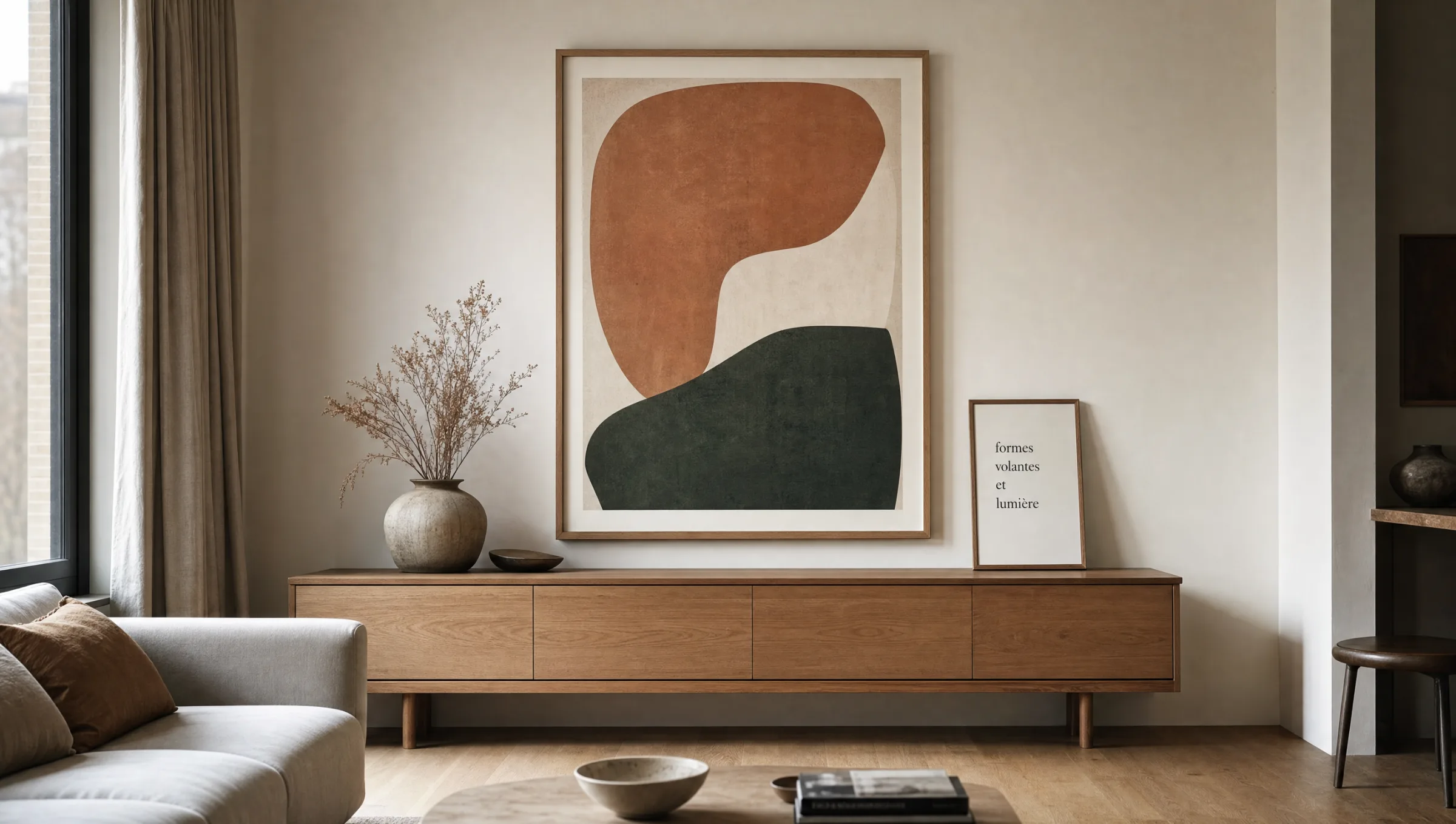
Generous compositions of just a few tones, often in muted palettes. They give structure to a wall without prescribing a concrete subject, and sit comfortably alongside wood, linen and matte wall paint.
Documentary Black-and-White Motifs
Architectural details, hands, textures — rigorously composed and printed with strong contrast. Removing colour shifts attention entirely to form and line.
Typographic Works
Reduced letterforms, quotations or type studies. When set well, they function as a graphic anchor in the room and stand in place of conventional pictorial art.
Format and placement: where unusual wall art has impact
Unusual wall art benefits from breathing room. A gallery hung too densely levels out its individuality, because the eye is forced to keep moving. It makes more sense to place a strong motif at the centre of a wall and leave space around it. This is especially true for unconventional crops or tall formats whose compositions need air to read properly.
For hanging height, the established rule of placing the centre of the image at roughly eye level — around 145 to 150 centimetres from the floor — holds up well. Above seating, the lower edge may come closer to the back of the furniture so that the piece and the furniture are read as a unit. Large-format prints from about 70 × 100 centimetres only fully come into their own when they are not hemmed in between shelves.
Lighting is a second consideration. Daylight from the side emphasises texture and paper surface, while a narrow wall light creates its own stage in the evening. Glossy surfaces reflect more strongly than matte ones — an argument for matte fine paper or canvas in strongly lit rooms.
An unusual picture does not require an unusual wall — it requires a wall that listens.
From the Reetro editorial team
Material and print: why the surface matters
Anyone who wants unusual wall art to make a lasting impression should not leave the material question to chance. FSC-certified fine papers of 200 g/m² or above with a matte coating give colours depth without overpowering them. They are particularly well suited to photographic and illustrative motifs where subtle gradients need to remain visible. Reetro has its prints printed to order by its production partner in the EU on FSC-certified papers, matching material to motif as an editorial decision rather than an afterthought.
Canvas reinforces the painterly quality of abstract works, while hexagonal aluminium panels produce a graphic, almost object-like effect — an interesting option for typographic or geometric motifs. Which combination works best is a question best answered by the individual motif rather than a blanket rule.
Combining unusual wall art without overcrowding
Several pieces of unusual wall art in one room can work well if a connecting element is present. That might be a shared colour palette, a consistent format or a recurring material theme — for instance, three prints on the same matte paper in different sizes.
Deliberate contrast can also be rewarding: a strictly graphic motif alongside a soft, almost painterly work. What matters is that the pieces do not compete with each other. If in doubt, hang one key piece first and add to it after a few weeks — the room usually shows clearly what it still needs.
Häufige Fragen
-
01
What sets unusual wall art apart from standard posters?
Unusual wall art differs less through bolder colours than through an independent visual language. That might mean an unexpected crop, a rarely depicted subject, a consistent reduction of colour or an unconventional material choice. Standard posters tend to rely on familiar subjects in predictable presentation, whereas unusual wall art deliberately breaks with established viewing habits. What counts is not the immediate effect but the consistency between motif, composition and print quality.
-
02
Which rooms work best for unusual wall art?
In principle, any room with enough wall space and a degree of calm. Unusual wall art works particularly well in living rooms, hallways and home offices, where people spend longer periods and daylight is available. In very small or already heavily furnished rooms, a single larger piece tends to be more effective than a wall full of prints. Bedrooms can benefit too, provided the motif is restrained enough not to activate the space.
-
03
What format suits unusual wall art?
It depends on the motif. Large-format works from around 70 × 100 cm read with confidence on a freestanding wall, while narrow tall formats work well beside doors or above slender furniture. Square formats calm a wall; elongated panoramic formats introduce tension. The key is that the print suits the wall and does not appear cramped — as a rough guide, at least half the image height of clear space should remain on all sides.
-
04
How do I combine several pieces of unusual wall art?
A unifying element helps: a shared colour palette, identical material or consistent framing. Three to four pieces in different sizes but on the same matte fine paper form a cohesive group. For those who want contrast, pairing a strictly graphic motif with a painterly work can read well — though both pieces should have enough distance between them. It is usually better to start with one main piece and build gradually from there.
-
05
Which material works best for unconventional motifs?
For photographic and illustrative works, matte fine paper of 200 g/m² or above is recommended, as it renders subtle gradients cleanly and avoids reflections. Abstract works often gain on canvas, where the visible texture adds to the painterly quality. Graphic and typographic motifs work well on aluminium — for example as a hexagonal panel — because the smooth surface supports the clarity of the form. Reetro has its prints printed to order by its production partner in the EU on FSC-certified papers and matches material to motif as part of its editorial process.