Tedox Wall Art: Range, Quality and Alternatives at a Glance
Anyone browsing a home improvement store for wall décor will quickly come across tedox wall art. This editorial overview puts the range into context, explains the typical formats and materials on offer, and outlines the key criteria for choosing between posters, canvases and glass prints.
What characterises tedox wall art
Tedox is known as a home improvement and renovation discounter, stocking not only flooring, curtains and decorative accessories but also a rotating selection of wall art. Tedox wall art typically includes framed prints, canvas-wrapped stretcher frames and glass prints in standard sizes. The range is aimed at buyers who want to decorate their living spaces economically and value being able to take something home the same day.
In terms of style, understated subject matter dominates: landscapes, abstract colour fields, floral still lifes and Scandinavian-style line drawings. Seasonal collections supplement the core range, so the exact selection varies by branch and time of year. Anyone looking for a specific motif should check availability in advance, as online ordering is not available for every product.
Compared with specialist print suppliers, tedox places greater emphasis on immediate availability than on curated editions or particular paper qualities. That is a deliberate positioning in the discount segment and should be taken into account when evaluating the products.
Typical product categories in the tedox wall art range
The assortment found in the home improvement store can broadly be divided into four recurring categories that are represented in most branches.
Framed prints
Classic paper prints behind glass or acrylic, usually set in narrow wood or plastic mouldings. Standard sizes such as 30×40 cm or 50×70 cm dominate, and they come ready to hang.
Canvas on stretcher frames
Film prints on stretcher frames in sizes up to around 80×120 cm. The canvas wraps around the edges so the piece can be mounted without an additional frame.
Glass prints
Motifs printed or laminated behind a glass panel. Visually very crisp, though comparatively heavy and vulnerable during transport.
Multi-panel sets
Two- to five-part compositions that spread a single motif across several frames or canvases. Well suited to large wall areas above a sofa or sideboard.
What to look for when buying tedox wall art
Because tedox wall art is primarily designed for immediate need, it is worth taking a close look at material details. The weight of the print paper is rarely stated, which makes it harder to draw conclusions about colour depth and light-fastness. With canvases, the depth of the stretcher bar is a useful indicator: well-made models have a depth of at least 2 cm, while thinner versions tend to warp over time.
The hanging method also deserves attention. Standard sawtooth hangers are sufficient for lightweight prints, but heavy glass prints require at least two fixing points and a suitable wall plug. Anyone with delicate walls should also note the weight, which is usually printed on the packaging or on the back of the piece.
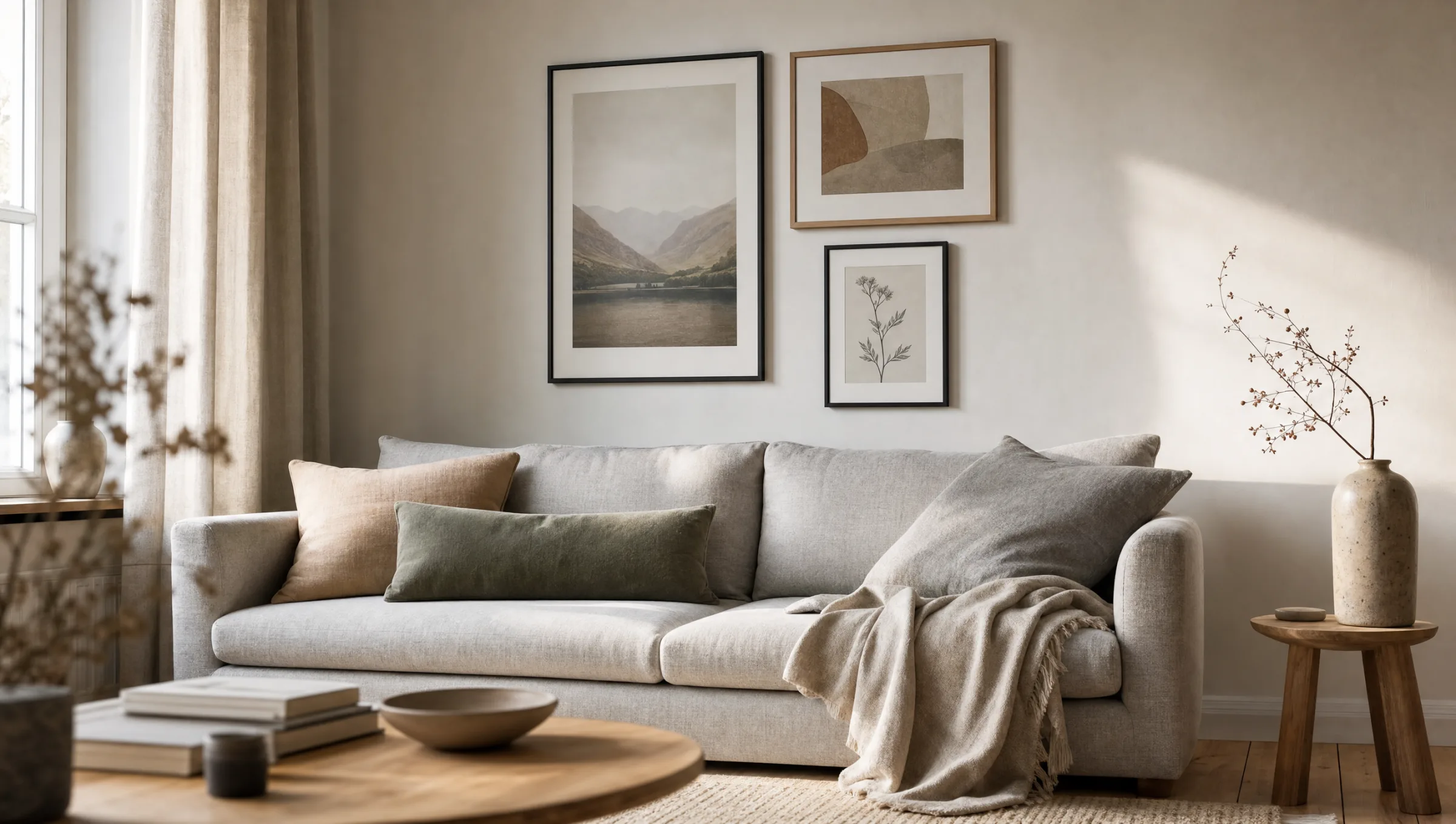
When comparing motifs, a photo of the wall with measurements is helpful. This makes it easier to judge on the spot whether a format suits the furniture. As a rule of thumb, a picture above a sofa should span roughly two thirds of the sofa's width, while a single piece above a sideboard should cover approximately half the width of the furniture.
A wall piece only looks calm when format, frame and motif are in harmony with one another — price alone does not determine how it reads in a room.
Reetro Editorial
Alternatives to tedox wall art: curated premium prints
Those who want to go beyond the standard range of a home improvement store will find a different approach to wall art at specialist suppliers such as Reetro. Instead of seasonal clearance stock, the focus is on editorially curated motifs printed on FSC-certified papers from 200 g/m² with a matte coating. Production takes place to order by our production partner in the EU, close to the customer, which keeps delivery times short and colour profiles consistent.
The format range also differs: alongside XXL posters for generous wall areas, the range includes premium canvases and hexagonal aluminium wall art. The latter are particularly robust and well suited to hallways or kitchens, where conventional paper prints tend to lose their freshness quickly.
The choice between tedox wall art and a curated premium supplier therefore depends less on price than on the desired standard for materiality, depth of subject matter and longevity. Both options have their place, but they serve different needs.
Care and lifespan of wall art
Regardless of whether a piece was bought from a discounter or a specialist retailer, location and care play a decisive role in how long it lasts. Direct sunlight causes colours to fade within a few years, particularly with unprotected paper prints. Positioning away from south- and west-facing windows noticeably extends the vibrancy of the colours.
Dust can be removed from smooth surfaces with a dry microfibre cloth. Glass prints can also be wiped with a lightly dampened cloth, whereas canvases should only be cleaned dry. Cleaning agents containing solvents should be avoided in all cases, as they can damage coatings.
Häufige Fragen
-
01
Can tedox wall art be ordered online?
The tedox wall art range is primarily geared towards in-store sales at physical branches. Individual promotional items do appear in online leaflets, but a full mail-order service for wall art is not part of the core business. Anyone looking for a specific motif should call the nearest branch in advance to check availability. Stock changes seasonally and varies by region.
-
02
What formats are common in the tedox wall art range?
Standard sizes such as 30×40, 40×50, 50×70 and 60×80 cm are typical for framed prints. Canvases often go up to 80×120 cm, and multi-panel sets cover combined wall widths of up to 150 cm. Custom sizes or individual cuts are not part of the range. For unusual wall niches or XXL formats, it is worth looking at specialist print suppliers.
-
03
How good are the materials used?
The materials correspond to the discount segment: printed paper behind acrylic or glass, film lamination on stretcher frames, or direct printing on glass. Paper weight and colour profiles are usually not stated in detail. For short-term decorating needs this is adequate, but long-lasting premium prints on FSC-certified paper with matte coatings are not to be expected in this range.
-
04
Are there alternatives to tedox wall art with higher print quality?
Yes. Specialist suppliers such as Reetro use papers from 200 g/m² printed to order by our production partner in the EU, matte surfaces and curated motif series. Premium canvases as well as hexagonal aluminium wall art also feature in their range. These products sit at a higher price point, but offer more stable colour profiles, longer-lasting materials and a clearer stylistic identity.
-
05
How do I hang tedox wall art safely?
Lightweight prints under two kilograms can be fixed with a single nail or an adhesive hook on smooth walls. Heavier canvases and glass prints require a wall plug and screw, ideally with two hanging points for added stability. The weight is usually noted on the packaging or on the reverse of the piece. On plasterboard walls, a suitable hollow-wall anchor is recommended.
-
06
Is it worth paying more for premium wall art?
It depends on your expectations. For temporary solutions, transitional homes or children's rooms, affordable pieces are a practical choice. If a motif is intended to hang in a prominent spot for many years, material quality pays off: heavier paper, precise colour profiles and matte coatings read more calmly and age noticeably better. Reetro, for example, has its motifs printed to order by our production partner in the EU on FSC-certified paper, setting a different quality benchmark.