
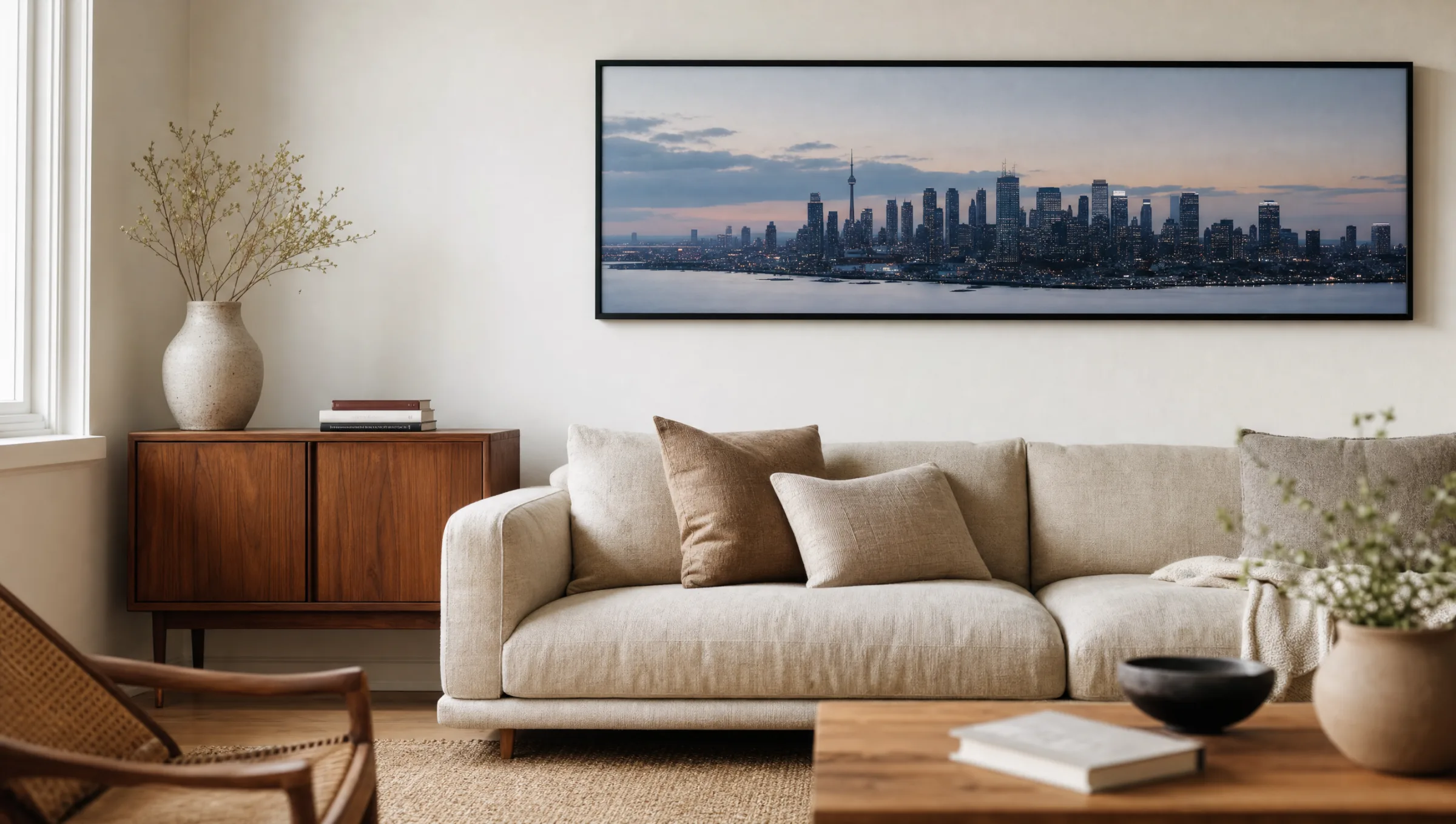
Skyline Print: Urban Motifs for the Wall
A skyline print condenses a city's profile into a clear graphic line. Whether New York, Frankfurt or Tokyo — the effect on the wall depends less on the motif itself than on format, crop and material. This overview covers the most important decisions in an editorial, practical way.
What Makes a Skyline Print
Skyline motifs show the distinctive profile of a city — usually in a horizontal orientation, often with a clear balance between sky, architecture and water or street level. The characteristic format is long and narrow: high-rises, towers and bridges form a continuous line that guides the eye across the image. This compositional logic sets a skyline print apart from conventional architectural photography and makes it a natural fit for panoramic formats.
In terms of content, skyline motifs fall broadly into three groups: the iconic daytime shot with a crisp silhouette, the blue-hour or night scene with pinpoints of light in the facades, and the graphically reduced version as an illustration, line art or single-colour print. Which variant suits best depends on the room, the existing colour palette and the desired sense of depth.
The vantage point of the shot also shapes its mood: a distant view across a river reads as calmer than an elevated perspective from a neighbouring building. Both have their place, but each speaks to a different atmosphere.
Popular Skyline Print Motifs at a Glance
Which city works best on a wall is often a matter of personal connection — but some skylines are particularly rewarding from a design perspective because their profile is instantly readable.
New York
Arguably the most recognised skyline in the world. The Empire State Building and One World Trade Center give the image a clear vertical rhythm that comes into its own in wide-format prints.
Frankfurt am Main
Germany's only classic high-rise skyline. The River Main in the foreground creates a calm reflective surface that adds depth to prints — ideal for blue-hour motifs.
Dubai
Defined by the Burj Khalifa and a very extended horizon line. Works particularly well in extremely wide panoramic formats from around 120 cm wall width upwards.
Hamburg
A lower, harbour-oriented skyline with the Elbphilharmonie as a visual anchor. Often reads as more refined in restrained black-and-white versions than in bold colour.
Format and Placement for a Skyline Print
Skyline motifs are almost always panoramas. Sensible aspect ratios lie between 2:1 and 3:1, and in special cases even 4:1. Above a sofa or sideboard the print should occupy roughly two-thirds of the furniture's width — narrower and it looks lost, wider and it becomes restless. For a standard three-seat sofa at 210 cm wide, an ideal print width is around 140 to 160 cm.
Hanging height should be guided by the eye level of a seated person, not a standing one: the centre of the image should sit approximately 140 to 150 cm above the floor when the skyline print hangs above seating. This preserves the visual relationship to the furniture line without the image drifting upward.
In a hallway, dining room or office, skyline prints also work well as a single elongated statement piece along a long wall. In bedrooms they read as more understated when the motif is kept in grey tones.
A skyline works on a wall like a horizontal staff of sheet music — the quieter the background, the more clearly the melody of the city can be read.
Reetro Editorial
Material: Paper, Canvas or Aluminium
On matte FSC paper from 200 g/m² upwards, skyline motifs appear graphic and calm — reflections are minimised and facade details remain legible. This option suits framed prints in living and working spaces with changing natural daylight. Printed to order by our production partner in the EU, these prints are produced to consistent archival standards.
Premium canvas brings out the painterly side of a skyline print, especially for blue-hour or sunset motifs. The slight texture of the weave softens hard points of light and gives the image a warmer feel. For a skyline print on canvas, depths of 2 to 4 cm are standard, depending on how much presence is desired on the wall.
Hexagonal aluminium wall panels are a special case: they break the motif into geometric modules and suit reduced line-art skylines rather than photographic night shots. Anyone looking for a classic panorama is better served by paper or canvas as a single, uninterrupted print.
Colour Palette and Room Context
Skyline motifs carry very different moods through colour. Daytime shots with a bright sky visually open up smaller rooms and suit Nordic-minimal interiors. Black-and-white or sepia skylines read as more restrained and combine well with wood, leather and natural tones.
Night shots with a warm light component call for a quiet wall behind them — ideally a muted grey, sage or warm white. Against strongly patterned wallpaper, skyline prints quickly lose their sense of depth.
Häufige Fragen
-
01
What format works best for a skyline print?
Skyline motifs call for panoramic formats. Aspect ratios between 2:1 and 3:1 are standard; for particularly elongated cities such as Dubai, a 4:1 ratio can also work well. When hanging above a sofa or sideboard, the skyline print should cover roughly two-thirds of the furniture's width — for a three-seat sofa that typically means around 140 to 160 cm wide. Square or portrait crops weaken the characteristic compositional logic of a skyline and are therefore rarely used.
-
02
Canvas or paper — which suits a skyline print better?
Both work, but each sends a different signal. Matte FSC paper from 200 g/m² emphasises the graphic quality of the motif and keeps facade details legible. Premium canvas makes the skyline print feel more painterly, softens hard light points in night shots and creates greater presence in the room. For framed, understated wall arrangements paper is a strong choice; for a frameless statement piece, canvas tends to work better.
-
03
How high should a skyline print hang above the sofa?
As a rule of thumb, the centre of the image should sit around 140 to 150 cm above the floor — roughly at the eye level of a seated person. A gap of 20 to 30 cm between the top of the sofa back and the bottom edge of the print feels comfortable. With very wide panoramas this gap can be slightly smaller so that the furniture and artwork read as a cohesive unit.
-
04
Do skyline motifs suit every interior style?
Generally yes, but the variant matters. Reduced black-and-white or line-art prints integrate well into Scandinavian, Japandi and mid-century-influenced rooms. Colour-rich night shots need quiet wall backgrounds and fit better in urban-modern or darker painted spaces. Against strongly patterned wallpaper, skylines tend to lose depth and definition.
-
05
How do you care for a large-format print over time?
Direct sunlight should be avoided, as even high-quality pigment prints lose brilliance with years of UV exposure. The surface can be dusted with a dry microfibre cloth. At Reetro, skyline prints are printed to order by our production partner in the EU on FSC papers from 200 g/m² with a matte coating, which reduces reflections and keeps the motif stable for years.