
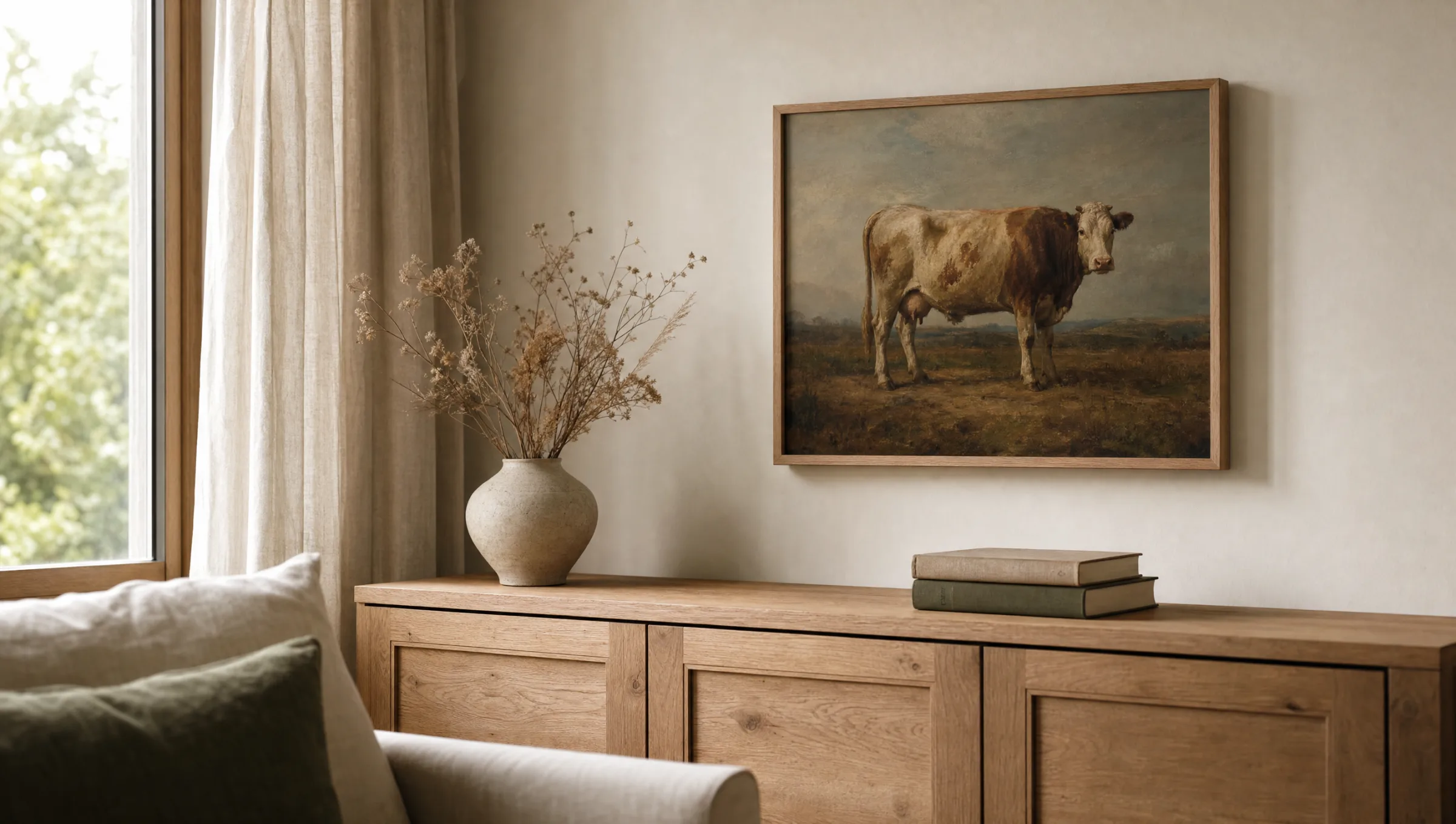
Painted Cows as Wall Art: Styles, Formats and Placement
Cows are among the oldest animal subjects in European painting. Painted cows combine rural calm with a strong pictorial presence, sitting comfortably in both modern interiors and classically furnished rooms. This overview offers an editorial look at styles, techniques and formats.
Why Painted Cows Have Remained a Subject in Their Own Right
From Dutch animal painting of the 17th century through the French Barbizon School to contemporary illustration, the cow has maintained a continuous presence as a pictorial subject. Paulus Potter, Aelbert Cuyp and later Rosa Bonheur established cows as a primary motif in their own right, not merely as staffage within a landscape. This tradition gives the subject a genuine art-historical footing.
In the home, painted cows therefore rarely read as pure decoration. They carry a quiet, almost meditative atmosphere into a room — one that derives from the soft contours of the animal and a typically earthy colour palette. In sparsely furnished spaces in particular, this creates a deliberate and considered contrast.
There is also a degree of iconographic openness to the subject: a grazing cow at the horizon reads quite differently from a frontal portrait in a large format. Both variations tell different stories without the motif itself ever becoming trite.
Four Styles of Painted Cows
The following styles appear most frequently in curated collections and print editions, and each suits a different living situation.
Classical Animal Painting
Detailed oil or watercolour work in the tradition of Cuyp and Potter. Warm earth tones, precise anatomy, often with open landscape in the background. Works well alongside wooden furniture and muted wall colours.
Impressionist
Loose brushwork, visible layers of colour, atmospheric light. The cow partially dissolves into fields of colour. Sits more lightly in bright, modern rooms than the classical style.
Graphic-Illustrative
Reduced line work, flat colours, typically on a light ground. This approach comes from Scandinavian print design and complements minimalist interiors well.
Surreal-Contemporary
Cows with floral crowns, placed in unusual settings, or rendered in strong colour distortion. A deliberately set eye-catcher that works well as a solo piece above a sideboard.
Painting Techniques Behind Painted Cows
The impact of painted cows depends greatly on the original technique. Oil paintings show deep shadows in fur and muzzle and lend themselves particularly well to large-format printing, as the brushwork structure is preserved. Watercolours feel lighter but rely on fine tonal transitions that are only reproducible on high-quality paper.
Gouache and acrylic sit between the two: opaque like oil, but more matte and graphic in character. Digital illustrations frequently reference these analogue traditions while working with clearly defined areas of colour. When selecting painted cows as a print, it is worth noting the technique, since it determines which printing surface will suit the image best.
A well-chosen painted cow is not a country-cottage cliché but a quiet pictorial anchor that brings calm to a room rather than filling it with noise.
Reetro Curatorial Note
Formats and Placement of Painted Cows in the Home
With painted cows it is worth considering the relationship between motif and wall area. Frontal portraits work convincingly in portrait format from 50 × 70 cm upwards, since the animal then meets the eye at roughly the right height. Side views or herd scenes call for landscape format and only come into their own at widths of around 80 cm or more.
Above sideboards and dining tables, generous landscape formats work well because the horizontal line of the land visually extends the piece of furniture. In hallways, smaller portrait formats make more sense, ideally hung as a pair or group of three.
On framing: classical oil subjects suit narrow wooden frames in oak or walnut, while illustrative versions often look better unframed or with a thin black aluminium frame. Reduced, graphic cow motifs come into their own particularly well on hexagonal aluminium panels.
Painted Cows in a Multi-Print Arrangement
In a salon-style hang, painted cows can be combined with still lifes, botanical prints or small-format landscapes. A shared colour temperature is important — usually earthy, slightly broken tones. Black-and-white photography alongside can reinforce the painterly character, provided those prints remain smaller in format.
If the motif is shown alone, allow at least 60 cm of clear wall around the frame. This breathing space prevents the picture from being lost among surrounding furniture and underlines its quiet, iconic presence.
Häufige Fragen
-
01
Are painted cows only suited to country-style interiors?
No. While classical oil-style painted cows do pair well with wooden furniture and muted colours, impressionist and graphic-illustrative painted cows work equally well in modern, minimalist or Scandinavian-influenced rooms. What matters less is the furniture style and more the colour coordination between image, wall and textiles. A reduced line-work motif on a light ground can actually read more restrained in a loft apartment than an abstract composition would.
-
02
What format works best for painted cows above a sofa?
Above a standard sofa of around 200 cm in width, image widths between 100 and 140 cm are generally recommended. For painted cows, a landscape format that accommodates a countryside setting or a herd works well — around 120 × 80 cm is a reliable choice. If a single cow portrait is intended to dominate, a square format of around 90 × 90 cm is also an option. As a rule of thumb, the bottom edge of the frame should sit 20 to 30 cm above the back of the sofa.
-
03
Which print surface suits painted cow motifs?
For classically rendered oil-style painted cows, a matte, lightly textured premium paper from 200 g/m² upwards is recommended — it makes the brushwork legible and reproduces muted colour nuances reliably. Watercolours benefit from a fine natural paper with a slight warm tone. Graphic-illustrative versions come through most clearly on smooth matte surfaces or as hexagonal aluminium wall panels. High-gloss surfaces are rarely appropriate, as they undermine the painterly character of the image. All Reetro prints are printed to order by our production partner in the EU on FSC-certified papers.
-
04
How do I combine several painted cows in a gallery wall?
A common thread is key — either through uniform frames or a consistent colour palette. A row of three differently rendered painted cows works when all motifs share a comparable tonality, such as earthy brown tones throughout. For larger groupings, one dominant main work paired with two to four smaller prints that complement thematically — landscapes, still lifes, other animals — tends to work better than simply repeating the cow motif across every piece.
-
05
Do painted cows hold a serious place in art history?
Yes. From at least Paulus Potter's 'The Young Bull' (1647) onwards, the cow was an independent primary subject in European painting. The Barbizon School, Rosa Bonheur in the 19th century and numerous modern positions have carried the motif forward. Painted cows are therefore part of a continuous tradition of animal painting, not a mere decorative genre.
-
06
How does Reetro select its painted cow prints?
At Reetro, painted cows are selected through an editorial curation process rather than pulled automatically from large image libraries. All prints are printed to order by our production partner in the EU on FSC-certified papers from 200 g/m² with a matte coating that faithfully renders fine brushwork and subdued colour nuances. For reduced, graphic variations, hexagonal aluminium wall panels and premium canvas options are also available, so the motif can be adapted to suit the specific room and context.