
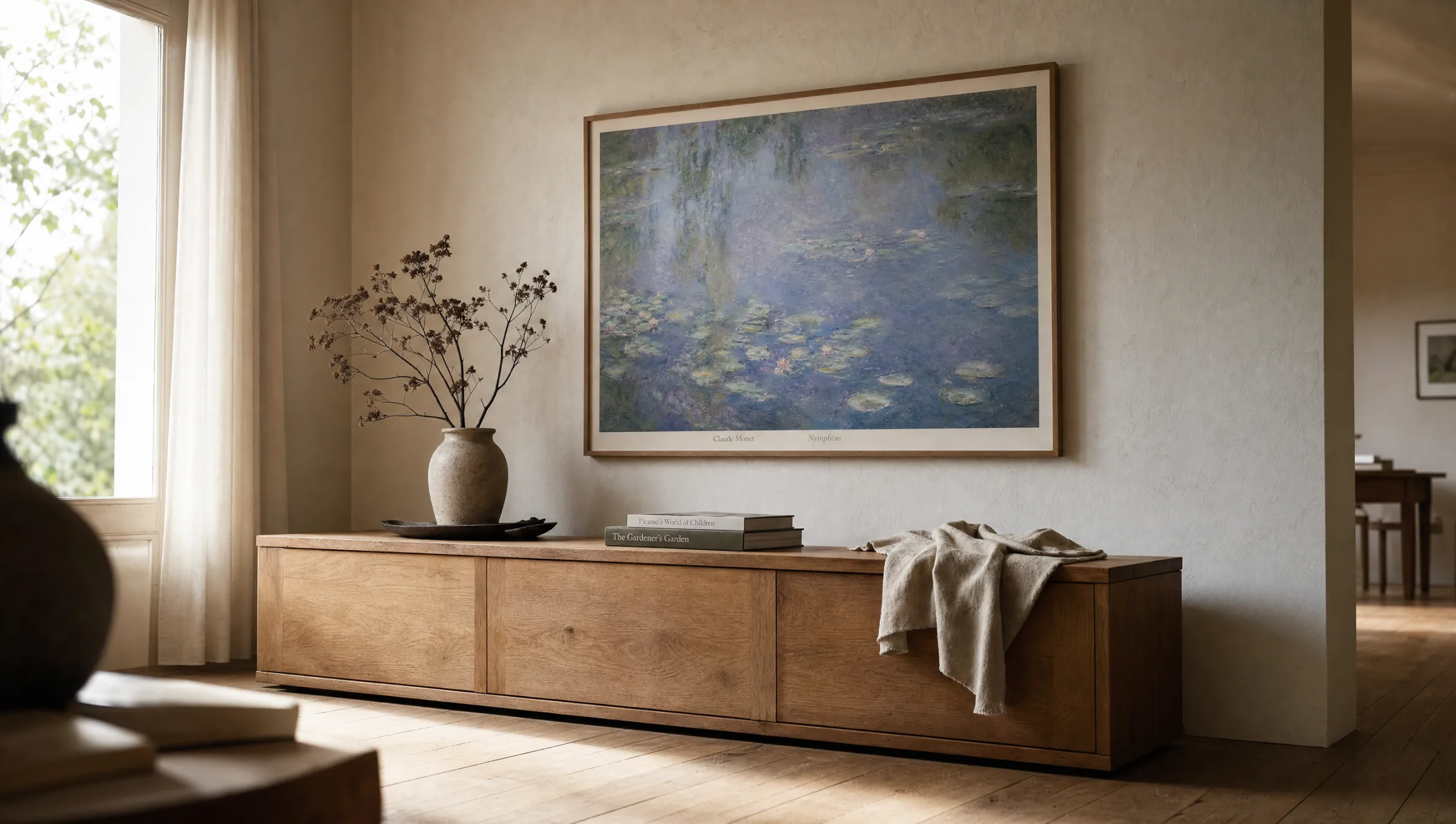
Monet Water Lilies – History, Visual Language and Wall Styling
Claude Monet's water lily paintings rank among the most reproduced motifs in art history. Hanging one on your wall is not simply a decorative choice — it quotes one of the most consequential moments in Impressionism. This page explains what makes these works distinctive and what to look for in a high-quality print.
Monet Water Lilies – The Making of a Lifelong Project
Claude Monet began in the 1890s to treat his garden in Giverny systematically as a studio. The Japanese pond he had constructed became the central subject of the last three decades of his career. The Nymphéas — the original French title — grew into a series of nearly 250 oil paintings capturing light, water reflections and plant growth at different times of day and season.
What sets Monet's water lilies apart from other Impressionist series is the consistent dissolution of pictorial space. There is no horizon, no fixed perspective and almost no clear boundary between surface and depth. The water functions simultaneously as mirror, plane and ground — a pictorial conception that anticipated abstract painting well into the twentieth century. Art historians regard the large-format late works now held in the Musée de l'Orangerie in Paris as direct precursors of American Abstract Expressionism.
The best-known individual works from the water lily cycle date from 1906 to 1926. During this period Monet's eyesight deteriorated significantly; he suffered from bilateral cataracts that altered his colour perception. Later paintings consequently display a warmer, yellowish-brown tone that differs markedly from the cooler blues and greens of his middle period — a distinction that should be clearly visible on any well-produced print.
Four Qualities That Define a Good Monet Water Lilies Print
Not every reproduction does justice to the quality of Monet's originals. When buying an art print, these four factors are worth examining closely.
Colour Calibration
Monet's palette depends on subtle transitions between blue, green, pink and yellow. Precise colour calibration using ICC profiles ensures that mid-tones neither shift towards harshness nor turn muddy — particularly critical for the reflections on the water surface.
Paper Weight & Surface
For Impressionist motifs, matte paper from 200 g/m² upwards is advisable, as glossy surfaces can obscure the brushwork of the original under raking light. FSC-certified heavyweight papers also offer better long-term stability and are used across Reetro's range.
Format Choice
Several of Monet's water lily compositions were conceived as panoramas. Formats from 70 × 100 cm give the pictorial space enough room for the spatial effect of the water reflections to register. Smaller formats work well for detail crops of individual flower clusters.
Border Treatment
A white border of 2–4 cm acts like a traditional mount and lifts the motif from the wall. A borderless, edge-to-edge print is a more contemporary option that gives the image a flatter, more graphic feel — both variants are available at Reetro.
Monet Water Lilies in Context – Materials and Hanging
Impressionist motifs such as the water lilies work well with a wide range of interior styles. In a period apartment with cornicing and wooden parquet, the earth tones of Monet's later paintings reinforce the warmth of existing materials. In a modern living space with plain walls and minimal ornament, the colour fields provide a quiet but definite accent.
For hanging, water lily motifs read best at eye level — that is, with the centre of the image approximately 145–155 cm from the floor. Because the compositions have no dominant vertical axis, they can also be used in wide landscape formats above a low sideboard or sofa without visually dominating the room.
Alongside a classic poster print, canvas is a natural choice for this motif. The woven texture of canvas references the impasto brushwork of Monet's originals as a visual cue, even when the image itself is flat-printed. Those seeking a more material-led effect might consider an aluminium Dibond print — the smooth, slightly cool surface gives the image a noticeably more contemporary character, making it well suited to offices or hallways with a more functional fit-out.
The water lilies are not a motif you explain — you let them work on you. That is precisely why they remain relevant after more than a hundred years.
Editorial observation, Reetro editorial team
Monet Water Lilies as Part of a Gallery Wall
The serial nature of Monet's water lily cycle makes the motif particularly suitable for multi-part arrangements. Two or three prints showing different sections of the cycle — for example, a cool early work alongside a warm ochre-toned late painting — create thematic coherence without feeling repetitive. Spacing between individual works should be consistent; 5–8 cm is a common recommendation for a tighter gallery-wall arrangement.
Alternatively, a large water lily format can be combined with smaller prints by other Impressionists. Camille Pissarro, Berthe Morisot and Alfred Sisley share similar colour palettes and approaches to light with Monet, so a mixed selection does not feel arbitrary. The key is to carry one shared colour element — a particular blue or green, for instance — through all the works in the arrangement.
Care and Longevity of Art Prints
Art prints featuring motifs such as the Monet water lilies are long-lasting provided a few basic guidelines are followed. Direct sunlight is the greatest threat to pigment-based prints: UV radiation causes colours to fade, particularly blues and reds. A position with indirect daylight or subdued artificial light significantly extends the lifespan of the print.
For cleaning, a dry, soft cloth is sufficient. Damp cleaning agents should be avoided on unframed posters, as moisture can soften the paper structure. Framed prints behind glass are considerably more robust; anti-reflective glass or acrylic reduces distracting glare without noticeably affecting colour reproduction.
Häufige Fragen
-
01
Which works belong to Monet's water lily cycle?
Monet's water lily cycle comprises around 250 oil paintings created in Giverny between 1896 and 1926. The most celebrated works are housed in the Musée de l'Orangerie in Paris, where eight large-format panoramic canvases fill two oval rooms. Further significant paintings hang in MoMA New York, the Art Institute of Chicago and the National Gallery in Oslo. The works vary considerably in colour mood and compositional density depending on when they were painted.
-
02
What format is recommended for a Monet water lilies art print at home?
For living spaces, from 50 × 70 cm upwards the motif begins to develop its full spatial presence. For hanging above a sofa or sideboard, 70 × 100 cm or a panoramic format such as 100 × 50 cm works well. Smaller formats like 30 × 40 cm suit detailed crops of individual flower clusters or narrower hallway walls. The key consideration is the ratio of image size to available wall space: the print should occupy roughly two-thirds of the wall's width.
-
03
Is a Monet water lilies print suitable for an office setting?
Yes, the motif works well in a professional environment because it is visually restrained and widely regarded in cultural terms. In a more functional office, a print on aluminium Dibond with a matte finish gives the image a contemporary character. In meeting rooms or reception areas, a large-format Monet water lilies work functions as a calm visual backdrop that does not draw attention away from the space's purpose.
-
04
How do early and late Monet water lilies differ in colour?
The early water lily paintings from 1896 to around 1908 display cool blues and greens with a relatively clear distinction between the water surface and reflected sky. The late works from 1914 onwards, produced under the influence of Monet's declining eyesight, are warmer, often yellowish-ochre in tone and less clearly structured. This difference is plainly visible on a well-calibrated print and is worth considering when choosing a motif to fit a specific colour scheme.
-
05
How do I care for a Monet water lilies art print correctly?
The most important protective measure is a position away from direct UV exposure. Indirect daylight or dimmed artificial light preserves the colour pigments over the long term. Unframed posters can be dusted dry with a soft microfibre cloth; moisture risks softening the paper. Framed prints behind anti-reflective glass are considerably more resilient and require almost no maintenance. Reetro uses FSC-certified papers from 200 g/m² with a matte coating, printed to order by our production partner in the EU, which are proven to offer high lightfastness.
-
06
Why are Monet water lilies considered so significant for modern art?
Monet's late water lily paintings dissolve the classical picture structure of foreground, middle ground and background. The water surface becomes a pure field of colour in which reality and reflection are inseparably merged. Art historians see a direct line from these works to the Abstract Expressionism of the 1940s and 1950s — painters such as Mark Rothko and Jackson Pollock explicitly acknowledged Monet as a reference. The water lilies thus mark a transition that helped shape the entire course of Western post-war painting.