
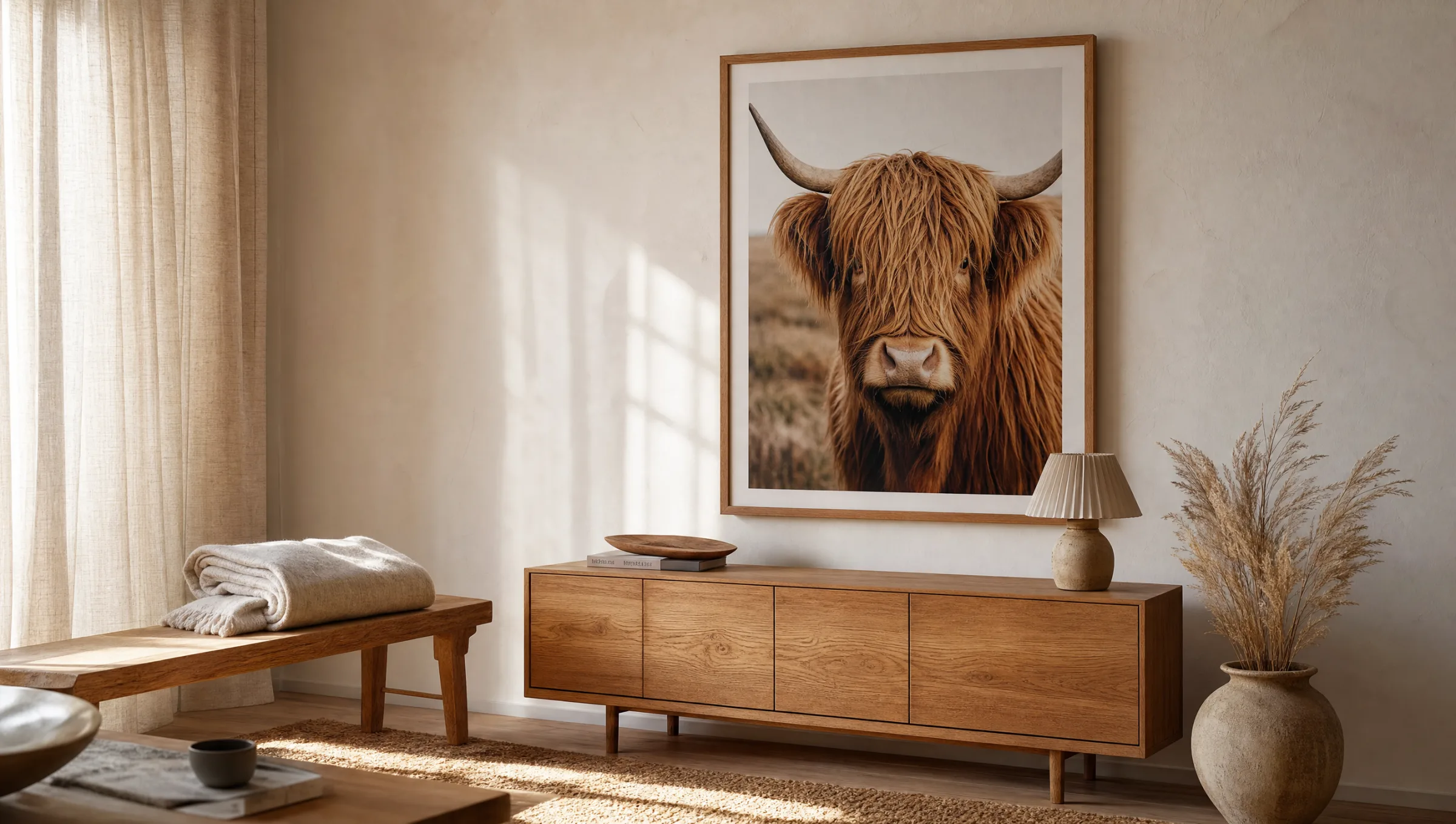
Highland Cattle Wall Art – Character Portraits for Your Walls
The Scottish Highland cattle is one of the most photogenic subjects imaginable: distinctive horns, long flowing hair, a calm and steady gaze. As a wall print it brings a natural presence that works equally well in modern and rustic interiors alike.
What Makes Highland Cattle Wall Art So Special?
The Highland cattle – sometimes called Scottish Highland cattle in English – is an animal with an unmistakable silhouette. Its long, wavy coat protects it from the Scottish climate and gives it an almost painterly texture that translates exceptionally well to photography. Close-up shots reveal individual strands of hair that catch the backlight like brushstrokes; wide-angle frames capture the vast highland landscape stretching out behind the animal.
Highland cattle wall art has steadily become a fixture in interior decoration over recent years – not as a passing trend, but as an expression of a preference for natural, unstaged subjects. The animal stands for authenticity and resilience, qualities many people want to feel in their homes.
The subject works across a wide range of contexts: as a single large-format landscape print above a sofa, as part of a multi-piece gallery wall in a hallway, or as a calm focal point in a study furnished with wood and natural materials.
Formats and Materials at a Glance
Highland cattle wall art reads differently depending on the material – from soft and atmospheric to crisp and detail-rich. The key substrates compared:
Premium Poster
Printed on FSC-certified papers from 200 g/m² with a matte coating, printed to order by our production partner in the EU. Ideal for interchangeable frames. The matte surface absorbs reflections and renders coat textures with exceptional subtlety.
Canvas Print
Stretched over a wooden frame, ready to hang without a separate frame. The slight weave texture gives the subject a crafted, tactile quality that suits nature-inspired motifs like the Highland cattle particularly well.
Aluminium Wall Print (Hexagon)
Printed directly onto aluminium dibond. The smooth, lightly glossy surface emphasises contrast and sharpness – well suited to black-and-white interpretations of the subject in contemporary rooms.
XXL Format
From 100 cm width onwards, individual strands of hair and the animal's characteristic gaze become room-filling details. Suited to high walls in living rooms or entrance areas.
Visual Styles: Which Approach Suits You?
Within the category of highland cattle wall art there is no single uniform look. Photographers and illustrators approach the subject in very different ways. Three main directions have proved themselves in practice:
Classic nature photography: the cattle in its surroundings, often in soft morning light or misty conditions. These images tell a story of landscape and season; the animal is part of a broader context. They suit living spaces with a quiet, earthy colour palette.
Close-ups and portraits: the animal's gaze directed straight into the camera, its coat as the dominant texture. Such images have a clear focal point and hold their own even in smaller formats from 50 × 70 cm upwards. Black-and-white interpretations are especially common here and integrate naturally into many different interior styles.
Graphic and illustrative versions: reduced line drawings or flat illustrations interpret the Highland cattle as a design object. This approach works particularly well when the image needs to fit into a graphically led interior concept.
The Highland cattle is one of the few animal subjects that needs no staging at all – the animal is its own image.
Reetro Editorial
Placement and Combination: Highland Cattle Wall Art in Interior Design
A single large highland cattle wall art print has the greatest impact when it hangs on a wall free of competing motifs. The colour palette of the subject – browns, rusts and greys – pairs naturally with warm wood furniture, linen fabrics and natural textures. Good companion pieces are botanical prints or abstract landscape images; additional animal portraits are best avoided.
For a gallery wall, three to five prints in coordinated formats work well. A reliable arrangement: one larger landscape format at the centre, flanked by two portrait-format prints or smaller squares. Uniform frames in light wood or slim metal keep the composition coherent.
In commercial spaces – offices, clinics, restaurants with a nature theme – black-and-white versions read as more professional and considered. The strength of the subject is retained without feeling overly personal.
Care and Handling of Posters and Canvas Prints
Posters on matte paper should not come into direct contact with water. Dust can be removed with a soft, dry cloth or a fine-bristle brush. When framed behind glass they are largely maintenance-free.
Canvas prints are more robust: a lightly damp cloth removes occasional dust without any difficulty. Direct sunlight over several years can cause colours to fade – a position away from prolonged direct light extends the lifespan of all prints considerably. Aluminium wall prints are the easiest to maintain and can be cleaned dry or lightly damp with a microfibre cloth.
Häufige Fragen
-
01
What size of highland cattle wall art works best above a sofa?
For a sofa wall, a width of at least 80 to 120 cm is recommended. The print should cover roughly two-thirds of the sofa's width. For a standard 200 cm sofa, a landscape format of 100 × 70 cm or 120 × 80 cm is well proportioned. Hang the print so that its lower edge sits approximately 20 to 30 cm above the back of the sofa – this creates a calm, unified wall area with no visual gap between the furniture and the artwork.
-
02
Does highland cattle wall art only suit rustic interiors?
Not at all. While Highland cattle prints feel most at home in rustic or country-house styles, they also work in modern and minimalist interiors – provided you choose the right execution. Black-and-white photographs or graphic illustrations of the subject fit well into pared-back, bright rooms. The substrate matters: aluminium prints or slim black frames give the motif a contemporary, non-rustic feel that sits comfortably in a wide range of settings.
-
03
What is the difference between a poster and a canvas print for Highland cattle motifs?
Posters on matte paper reproduce fine details such as the animal's coat with great clarity, because the surface generates no reflections. Canvas prints carry a warmer, more tactile quality through their weave structure, which many people find more fitting for nature-inspired subjects. Posters are generally more affordable and easier to swap out; canvas prints work as standalone objects without a frame and are more resistant to humidity in the room.
-
04
Which colour palette pairs well with highland cattle wall art?
The Highland cattle's coat brings rust, caramel and warm brown tones into play. These harmonise naturally with neutral shades such as cream, sandy beige, muted green and dark olive. For a more contemporary look, black-and-white versions of the motif combine with almost any wall colour. Bold complementary colours such as blue or orange are possible but require a deliberate decorating decision and will read as deliberately high-contrast rather than understated.
-
05
How do I hang a large-format Highland cattle print safely?
Posters from 70 × 100 cm upwards should be fitted in a sturdy frame and secured to the wall with at least two hanging points. For canvas prints, two screws spaced roughly one third of the print's width apart are recommended. Aluminium wall prints often come with an integrated security spacer. Use hollow-wall anchors in plasterboard; standard plugs with 6 mm screws are sufficient for concrete walls. A spirit level ensures the print is perfectly straight when positioning it.
-
06
What print quality does Reetro use for highland cattle wall art?
At Reetro, all posters are printed on FSC-certified papers from 200 g/m² with a matte coating, printed to order by our production partner in the EU. The matte surface is particularly suited to animal subjects, rendering contrast and coat textures without any reflections. Canvas prints are produced on a durable cotton-polyester blend and stretched over solid spruce wood frames. All materials are designed for longevity and are free from acid-containing components.