
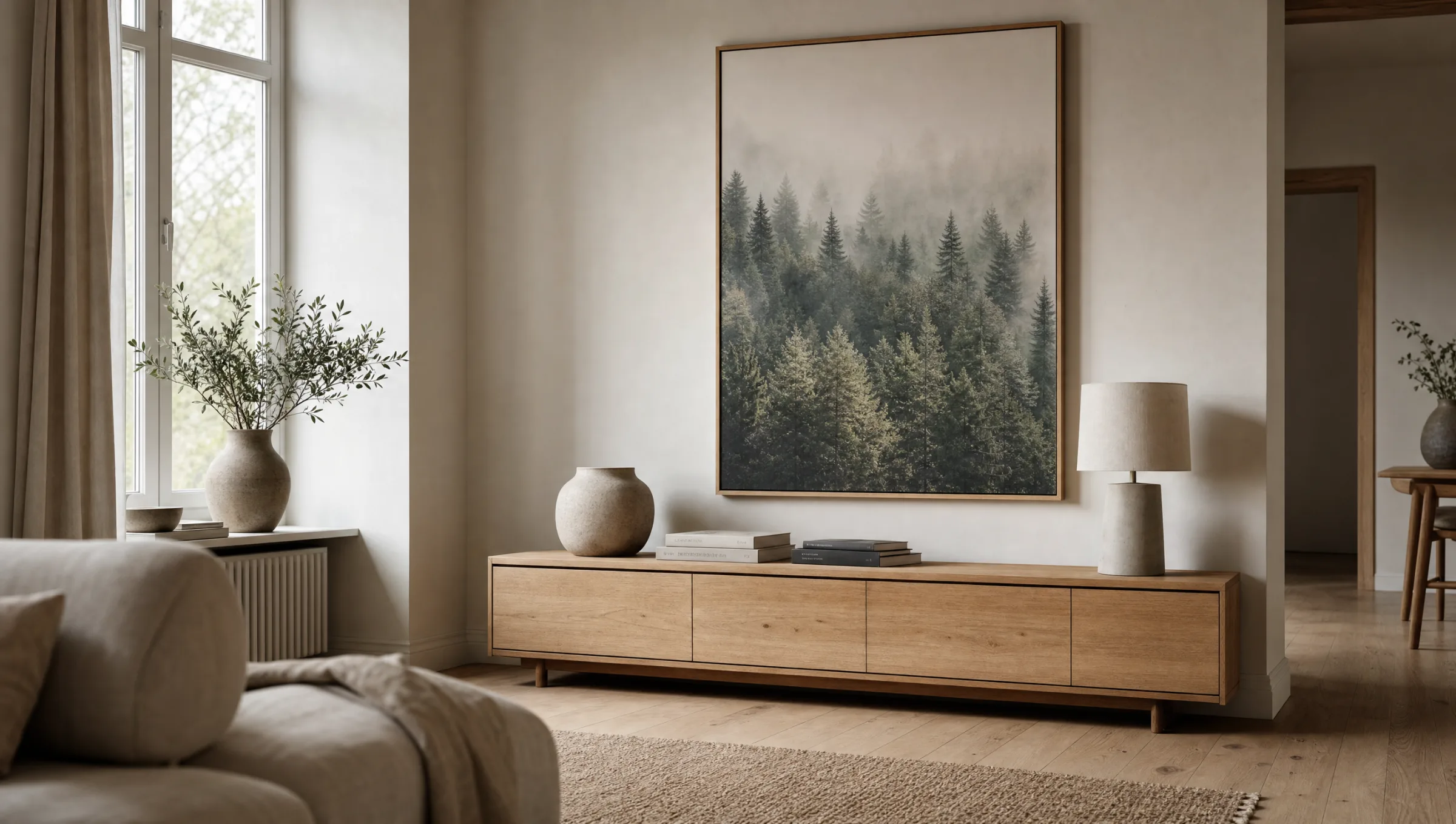
Forest Wall Art: Motif Styles, Materials and Hanging
Forests are among the most chosen nature motifs for wall decoration. This overview organises the key visual styles, materials and formats, and explains when a Nordic mist motif works best — and when a high-contrast autumn scene suits the interior better.
The Visual Directions That Define Forest Wall Art
Forest wall art can carry very different moods. Three main directions are consistently popular: Nordic coniferous forests in mist, open deciduous forests with shafts of sunlight, and dense mixed forests in autumn colour. Each works in a different room context and with a different lighting situation.
Misty forests are tonally restrained, often rendered in grey and petrol hues. They feel calm and suit rooms with light walls and subdued lighting. Sun-filled beech forests with long shadows create depth and work well in hallways or stairwells, where the image is taken in while passing by.
Autumn forests with reds, oranges and ochres are the highest-contrast option. They introduce a clear colour accent and are often hung above sofas or sideboards, where they echo the warmer material world of wood and textiles.
Materials for Forest Wall Art Compared
The impact of a forest motif depends greatly on the material. Three formats have established themselves — each with its own character in depth, reflection and texture.
Premium Canvas
Canvas reduces reflections and gives dense forest scenes a painterly depth. Particularly well suited to mist and morning-light motifs where subtle grey gradients should not catch a glare.
FSC Poster Paper from 200 g/m²
Matte-coated fine art paper renders detail in foliage and bark with precision. A strong choice for graphically clear photographs and for gallery walls featuring several framed formats.
Hexagon Aluminium
Honeycomb-shaped aluminium wall panels suit modern interiors. The cool surface underlines the graphic character of reduced forest silhouettes.
XXL Format
Large-format forest wall art from 100 cm upwards is particularly effective because the sense of depth only fully emerges beyond a certain image size. Recommended for walls without competing furniture edges.
Format and Hanging: Placing Your Forest Wall Art
Forest images benefit from portrait or panoramic formats because they accommodate the natural verticality of the trees or the breadth of the woodland. Square crops work when the motif is strongly centred — for example, a single free-standing oak.
A reliable guideline for hanging height is to position the centre of the image at around 145 to 150 centimetres above the floor. Above sofas and sideboards, the print should span roughly two-thirds of the furniture's width so that wall and motif stay in balance.
When hanging a series of prints, a consistent gap of four to six centimetres between frames is recommended. This creates a calm visual line without the individual motifs blurring into one another.
A good forest print does not replace a window — but it creates the same moment of pause when you walk into the room.
Reetro Editorial
Colour Coordination: Forest Wall Art with Walls and Furniture
Warm wood tones, linen and wool fabrics harmonise with autumn and deciduous forest motifs. Combining oak furniture with cream-coloured walls, a high-contrast forest print can create a focal point without disrupting the material palette.
For cooler interiors featuring greys, black steel or concrete, misty forests and black-and-white interpretations are a better fit. They absorb the room's reduced colour palette and reinforce the calm atmosphere rather than creating a clash.
In children's rooms and workspaces, illustrated or graphically simplified forest motifs often work better than highly realistic photographs, as they demand less sustained visual attention.
Care and Longevity
High-quality prints on FSC-certified paper or premium canvas remain colour-stable for many years provided direct sunlight and prolonged moisture are avoided. A position opposite a window rather than in the direct beam is ideal.
Dust can be removed dry with a soft microfibre cloth. Matte-coated surfaces should not be treated with cleaning agents — plain water is sufficient in the rare cases where cleaning is necessary.
Häufige Fragen
-
01
What format works best for forest wall art above a sofa?
Above a standard sofa of 200 to 220 centimetres in width, a landscape-format forest wall art print between 120 and 150 centimetres wide tends to look most balanced. It occupies roughly two-thirds of the furniture's width and leaves adequate breathing room on either side. A portrait format of approximately 70 by 100 centimetres also works when hung centrally. The key is the gap between the bottom of the print and the sofa back: 20 to 30 centimetres is a reliable guideline.
-
02
Canvas or poster — which suits a forest motif better?
Both are valid choices. Canvas has a more painterly quality, reduces reflections and emphasises the depth of misty or darker forest scenes. High-quality poster paper from 200 g/m² with a matte surface renders fine detail in foliage and bark with particular precision and can be classically framed. For gallery walls combining several motifs, framed posters are often the quieter option; for a single large-format statement piece, canvas is well suited.
-
03
How high should forest wall art be hung?
As a general rule, the centre of the image should sit at around 145 to 150 centimetres above the floor — roughly average eye level when standing. Above furniture, the hanging height is guided by the top edge of the piece: a gap of 20 to 30 centimetres creates a visual connection without the print and furniture appearing to merge. In dining rooms the print can hang a little lower, since viewers are primarily seated.
-
04
Which wall colour pairs well with forest wall art?
Muted, warm neutrals such as off-white, sand beige or a pale greige bring out the natural quality of a forest motif without competing with the image colours. Cool greys harmonise with misty forests and black-and-white interpretations. Deeper wall colours such as dark teal or forest green can work when the print itself is tonally restrained and is framed to create a clear visual boundary.
-
05
Will forest wall art fade over time?
With pigment-based printing on quality paper or canvas, colour stability is maintained for many years provided prolonged direct sunlight is avoided. Rooms with high humidity, such as bathrooms, are less suitable. Reetro prints to order through its production partner in the EU on FSC-certified fine art paper from 200 g/m² with a matte coating — a material construction designed for low-reflection presentation and good long-term ageing properties.