
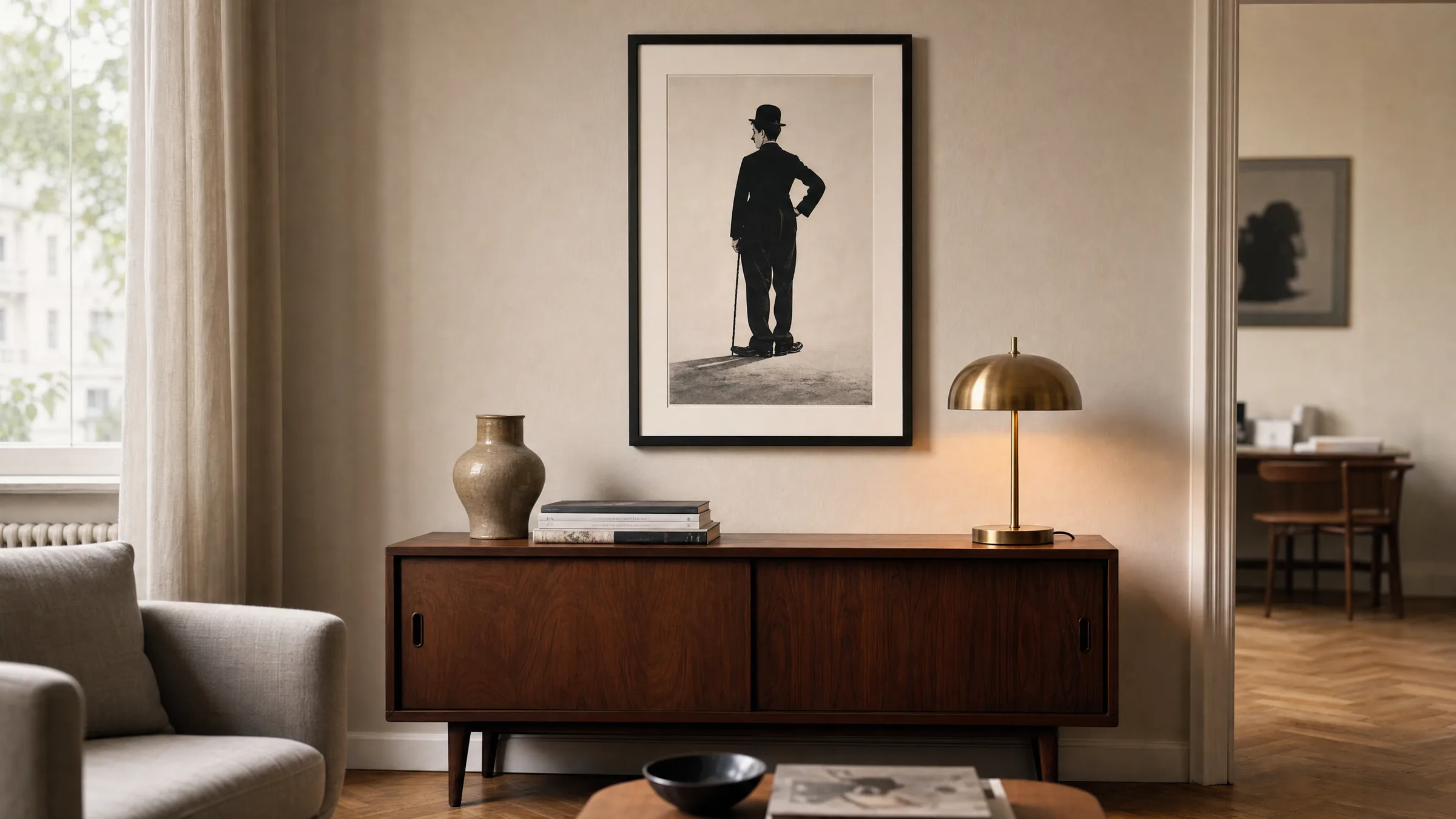
Charlie Chaplin Print: The Iconography of the Silent Film Era on Your Wall
A Charlie Chaplin print connects film history with a clear graphic language. The bowler hat, cane and black-and-white contrasts have condensed into their own visual grammar — one that works just as well away from the cinema. This editorial overview covers motifs, formats and paper types for anyone considering adding Chaplin to their walls.
Why a Charlie Chaplin Print Still Works Today
Few figures from the early twentieth century have been reproduced as often as the Tramp. The silhouette of bowler hat, thin moustache, baggy trousers and cane reduces Chaplin to just a handful of lines — making him one of the most graphically rewarding motifs in film history. A Charlie Chaplin print works equally well as a photographic still reproduction from films like 'Modern Times' or 'The Kid' and as a reduced illustration in a vintage style.
There is also the historical depth to consider: Chaplin's work spans the transition from silent film to early sound cinema, an era whose aesthetic is frequently referenced today. Black-and-white photography, grainy film stock and the characteristic lighting of the 1920s and 1930s sit naturally in interiors that mix vintage furniture, warm wall colours and modern accents.
Motif Styles for a Charlie Chaplin Print
The most common motifs can be grouped into four broad categories, each distinct in style and visual impact.
Black-and-White Film Stills
Classic frame captures from 'The Tramp', 'City Lights' or 'Modern Times'. High in detail, documentary in character, well suited to larger formats from 50 × 70 cm upwards.
Illustrative Silhouettes
Reduced drawings that distil Chaplin to bowler hat, cane and outline. Graphically clean, ideal for minimalist interiors and gallery walls.
Portrait Studies
Close-up views of the face, often colourised or rendered as duotones. They highlight expressive detail and suit smaller formats at eye level.
Typographic Prints
Combinations of quotation and image, such as excerpts from Chaplin's speech at the end of 'The Great Dictator'. Text-led, with strong legibility on matte paper.
Format, Paper and Framing
For a Charlie Chaplin print, formats that do justice to the film-still character are recommended. Portrait formats from 50 × 70 cm upwards show full-length images of the Tramp without visual compression, while 30 × 40 cm works well for portrait crops in gallery wall arrangements. Panoramic or landscape formats suit scene images featuring multiple figures.
On paper, it is worth paying attention to weight and surface. Matte papers from 200 g/m² upwards suppress reflections and allow the fine grey tones of black-and-white motifs to read quietly. Gloss surfaces intensify contrast but can give film stills a more poster-like feel than intended.
For framing, slim wooden mouldings in black, natural or stained walnut are a good match. Off-white mounts create a calm border around portrait or silhouette motifs and draw the image slightly back into the depth of the frame.
A well-chosen Chaplin motif needs no loud framing — its visual language already carries enough history to hold its own in a room.
Reetro Editorial
Placing a Charlie Chaplin Print in a Room
Black-and-white motifs sit well against warm wall colours such as off-white, sand or muted ochre. Against darker walls — anthracite or deep forest green, for instance — the lighter areas of the image gain presence, which is particularly effective with portrait studies.
On a gallery wall, a Chaplin motif can be combined with other film prints from the silent era, architectural photography from the 1920s or typographic works. A consistent frame finish, or at least a coherent colour family across frames, helps the wall read as a composed whole.
In studies and reading rooms, smaller formats at eye level work well; in living rooms, larger single motifs above a sofa or sideboard make a considered statement. A gap of roughly 20 to 30 cm between the base of the frame and the top of the furniture keeps the composition settled.
Care and Longevity
Direct sunlight should be avoided, as UV light gradually fades even pigment-based prints over the years. Rooms with indirect natural light are ideal for a Charlie Chaplin print. For framed pieces, anti-reflective glass adds further protection against glare and minor mechanical contact.
Unframed prints store best lying flat between two sheets of card, or rolled in a postal tube with an adequate diameter. When unpacking, placing the print flat under a light weight for a few hours allows any rolled edges to relax before it is placed in a frame.
Häufige Fragen
-
01
Which motifs work best for a Charlie Chaplin print?
Four motif groups are most commonly sought: original film stills from works such as 'Modern Times', 'City Lights' or 'The Kid'; reduced silhouettes of the Tramp; portrait studies focused on facial expression; and typographic prints featuring quotes from Chaplin's speeches. The choice depends on the interior: film stills and portraits have a narrative quality that suits classically furnished rooms, while silhouettes and typographic works fit well into minimalist or Scandinavian-influenced spaces.
-
02
What format makes sense for a Charlie Chaplin print?
For single motifs above a sofa or sideboard, formats from 50 × 70 cm or 70 × 100 cm are recommended, as the detail of the film image resolves clearly at that scale. In gallery walls or hallways, smaller formats such as 30 × 40 cm or 40 × 50 cm work well, especially when several motifs are combined. Panoramic formats suit scene-based stills featuring more than one figure.
-
03
Do black-and-white prints suit coloured walls?
Yes. Black-and-white motifs are neutral in tone and can be hung on coloured walls without difficulty. Warm shades such as off-white, sand or muted ochre work particularly well, as do darker colours like anthracite, deep forest green or a rich navy. The key is for the frame to either clearly contrast the wall colour or follow it within a related tonal family, so the image sits calmly on the wall.
-
04
How do I frame a Chaplin motif without it looking overly nostalgic?
Rather than gold or heavily ornate mouldings, slim and understated frames are the better choice. Black-lacquered wood, oiled oak or walnut bring the motif into a contemporary setting without suppressing its historical character. An off-white or natural-white mount gives the image breathing room and draws it slightly back within the frame. Anti-reflective glass further reduces glare and keeps the surface clean-looking.
-
05
What paper quality is recommended for a Charlie Chaplin print?
For black-and-white motifs, matte fine-art paper from 200 g/m² upwards is a considered choice, as it renders grey tones with nuance and avoids reflections. At Reetro, prints are printed to order by our production partner in the EU on FSC-certified papers with a matte coating; this combination produces stable edges, deep blacks and an even surface that reads consistently even under raking light.