Art Forms of Nature: Ernst Haeckel's Plates as Wall Art
Between 1899 and 1904, Ernst Haeckel published his landmark plate work, shaping the transition from Art Nouveau to modern visual science. This overview contextualises the key motifs, discusses material choices and hanging arrangements, and explains how these lithographs translate into contemporary interiors.
What Makes Art Forms of Nature Unique
Between 1899 and 1904, Ernst Haeckel published one hundred plates in Leipzig and Vienna under the title Art Forms of Nature, making it one of the most influential illustrated works of the turn of the century. The Jena-based zoologist combined meticulous microscopic observation with graphic composition: radiolarians, jellyfish, starfish, orchids and bats appear not as incidental findings but as rigorously symmetrical arrangements.
The original lithographs were executed largely by Adolf Giltsch from Haeckel's drawings, producing a visual language that bridges scientific plate and ornamental print. This dual nature is precisely why Art Forms of Nature continues to work as wall art today: the plates carry historical authority alongside a clear, almost modernist pictorial order.
Four Central Motif Groups
From the hundred plates, four thematic clusters emerge that have also proved their worth when selecting works for the wall.
Radiolarians and Micro-organisms
The delicate silica skeletons of single-celled marine organisms open many of the plates and are considered Haeckel's most iconic motif. Their geometric rigour reads almost like a prefiguration of Bauhaus visual vocabulary.
Jellyfish and Polyps
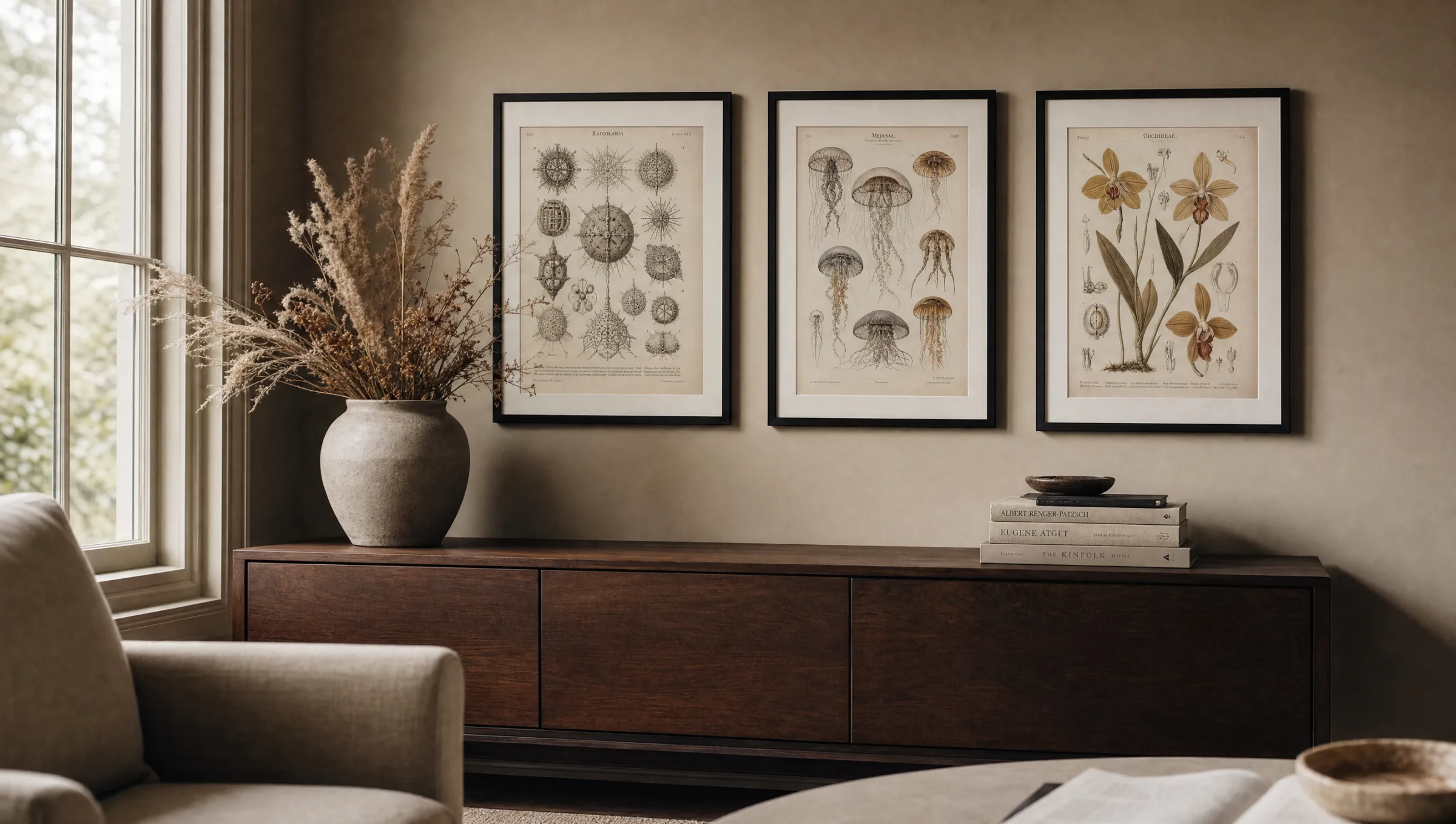
The Discomedusae and Siphonophorae plates depict floating organisms with long trailing tentacles. They suit tall vertical formats well and bring a sense of movement to an otherwise still picture wall.
Botanical Plates
Orchids, ferns and diatoms combine floral tradition with precise observation. This group reads quietly and suits living spaces where a restrained connection to the natural world is sought.
Vertebrates and Insects
Bats, hummingbirds and beetles appear as ordered rows. The symmetrical arrangement recalls museum display cases and works particularly well in a study or library.
Using Art Forms of Nature in a Living Space
The impact of the plates depends greatly on format and framing. Larger sizes from 70 × 100 cm emphasise the ornamental quality and work well as a single statement piece above a sideboard or sofa. Smaller formats lend themselves to serial hanging: three to six plates at equal spacing create a row that echoes museum display panels.
For the surrounding wall colour, muted tones such as warm greige, sage or deep charcoal work well. Against white walls, the historical annotations and fine linework read with greater clarity, while darker shades deepen the tonal range of the lithographs. When combining several motifs, staying within one thematic group helps to keep the arrangement cohesive.
For materials, matte FSC-certified paper from 200 g/m² upwards is a reliable choice: it avoids reflections and renders the fine lines cleanly. Premium canvas suits the more organic motifs such as jellyfish, while aluminium wall prints accentuate the geometric precision of the radiolarians. All Reetro editions are printed to order by a production partner in the EU.
Nature produces from her teeming womb an inexhaustible abundance of wondrous forms, whose beauty and variety far surpass all the art forms created by man.
Ernst Haeckel, Preface to Art Forms of Nature, 1904
Print Quality and Reproduction of Art Forms of Nature
Because the original plates were printed as lithographs, high-resolution source scans and restrained colour correction are essential in any reproduction. The yellowing of the original paper is gently balanced in reputable editions without stripping away the historical character. The typical warm toning remains visible and distinguishes a considered reproduction from an over-processed one.
Reetro prints Art Forms of Nature to order through a production partner in the EU on FSC-certified papers with a matte coating. The plates retain their quiet, paper-like character and can be framed behind glass or stretched onto canvas without difficulty. For larger wall surfaces, the XXL format is recommended, as it allows the lithographs' fine linework to come through with particular clarity.
Art-Historical Context
Art Forms of Nature emerged at the intersection of natural science, Art Nouveau and early design theory. Architects such as René Binet drew directly on Haeckel's radiolarian plates — most visibly in the entrance portal of the 1900 Paris World Exhibition. Émile Gallé and the artists of the Vienna Secession also absorbed ideas from the biological forms Haeckel documented.
During the twentieth century the work remained present but was also critically reassessed: Haeckel's stylised representations deviated at certain points from biological reality. For those hanging the plates today, that is less relevant than the formal achievement they represent. Displaying Art Forms of Nature brings a piece of the history of science into a room — one that can equally be read as an autonomous work of graphic art.
Häufige Fragen
-
01
Who created Art Forms of Nature?
Art Forms of Nature was created by the German zoologist Ernst Haeckel (1834–1919). Between 1899 and 1904 he published a total of one hundred plates, issued in ten instalments and released as a complete edition in Leipzig and Vienna in 1904. The lithographs were executed largely by Adolf Giltsch from Haeckel's detailed preparatory drawings. Haeckel was Professor of Zoology at the University of Jena and is regarded as one of the most important popularisers of evolutionary theory in the German-speaking world.
-
02
Which motifs from Art Forms of Nature work best as wall art?
The radiolarian plates are particularly sought after, because their geometric rigour translates readily into modern interiors. Jellyfish plates such as Discomedusae also work very well in tall vertical formats, as the trailing tentacles reinforce the vertical picture axis. Botanical motifs — orchids, ferns, diatoms — suit quieter living areas, while bats and hummingbirds, with their symmetrical rows, recall classical museum display cases and sit well in a study or library.
-
03
Are the Art Forms of Nature plates in the public domain?
Yes. Ernst Haeckel died in 1919, which means his works have been in the public domain in Germany and most other countries since the early 1990s. The plates may therefore be reproduced and printed freely. Quality differences arise from the scan sources used, the degree of colour correction applied and the printing process. High-quality reproductions work from high-resolution library scans and preserve the warm paper toning of the originals rather than artificially brightening them.
-
04
What format is appropriate for a plate from Art Forms of Nature?
The original plates are portrait-format sheets of approximately 27 × 36 cm. For domestic interiors, sizes from 50 × 70 cm work well; on generous walls, 70 × 100 cm or larger is appropriate. When hanging several plates as a series, format and frame should be identical, with a gap of ideally four to six centimetres between each image. For a single piece above a sofa or sideboard, a format roughly two-thirds the width of the furniture beneath it tends to sit well.
-
05
What material is best suited for Art Forms of Nature prints?
Matte premium paper from 200 g/m² is the natural choice: it renders the fine lithographic lines without glare and stays closest to the historical character of the originals. Premium canvas suits organic motifs such as jellyfish, where the texture complements the soft linework. Aluminium wall prints, by contrast, underscore the geometric precision of the radiolarian plates. Reetro prints all Art Forms of Nature editions to order through a production partner in the EU on FSC-certified matte paper, so different material variants can be combined within a single series without any visual mismatch.