
Affordable wall art – what really matters when balancing price and quality
Shopping on a budget does not mean settling for poor print quality. Anyone looking to buy affordable wall art benefits from a clear understanding of format, paper weight and motif selection. This page outlines where savings are genuinely worth making, where material quality still counts, and how a coherent wall arrangement can be built from a modest budget.
What does budget-conscious mean when buying wall art?
The word affordable is relative and depends heavily on format, printing method and paper. An A3 poster on 200 g paper will inevitably cost less than a large-format canvas on a stretcher frame. To make sense of a price, it helps to compare paper weight, print type and framing – not just the number on the label.
It is equally important to consider how long a print should last. Pigment inks and FSC-certified paper are more durable than basic inkjet prints on thin stock. A modest additional investment in materials often pays off within a few years, because colours remain stable and the paper does not warp.
Where you can save when buying affordable wall art
Not every variable affects the final price equally. This overview shows where costs can be reduced without weakening the visual impact on the wall.
Choose standard formats
Standard sizes such as 30×40 cm or 50×70 cm cost less than custom dimensions. They also fit readily available off-the-shelf frames, which keeps the total outlay down.
Order unframed
Rolled prints without a frame reduce the price noticeably. A matching frame can be added separately later, or replaced with simple poster clips for a minimal look.
Combine sets
A multi-print gallery wall built from smaller formats has a generous feel and is often cheaper in total than a single oversized motif.
Motifs without licensing fees
Curated in-house editions and public-domain classics are generally more affordable than prints licensed from major photo agencies.
Materials compared: affordable wall art with substance
Posters on matte fine-art paper from 200 g/m² upwards offer an accessible entry point without looking cheap. The matte surface reduces reflections, which is especially noticeable in bright rooms. Anyone planning to display a print long term should look for paper that stays flat and holds its colour faithfully.
Canvas prints sit at a higher price point but arrive ready to hang without an additional frame. Aluminium wall panels – including hexagonal formats – are more robust and suited to kitchens or bathrooms. Those who want flexibility can start with posters and introduce higher-quality materials for key motifs in living areas later on.
A common misconception is that thinner paper is automatically cheaper and therefore sufficient. In practice, the material cost difference between 170 g and 250 g stock is just a few pence per sheet, yet the difference in feel and stability is clearly noticeable. When buying affordable wall art, it is always worth checking the stated paper weight.
Shopping on a budget does not mean buying cheap – it means deciding consciously where materials matter and where the motif alone carries the effect.
Reetro Editorial
Motif selection: buying affordable wall art and combining it well
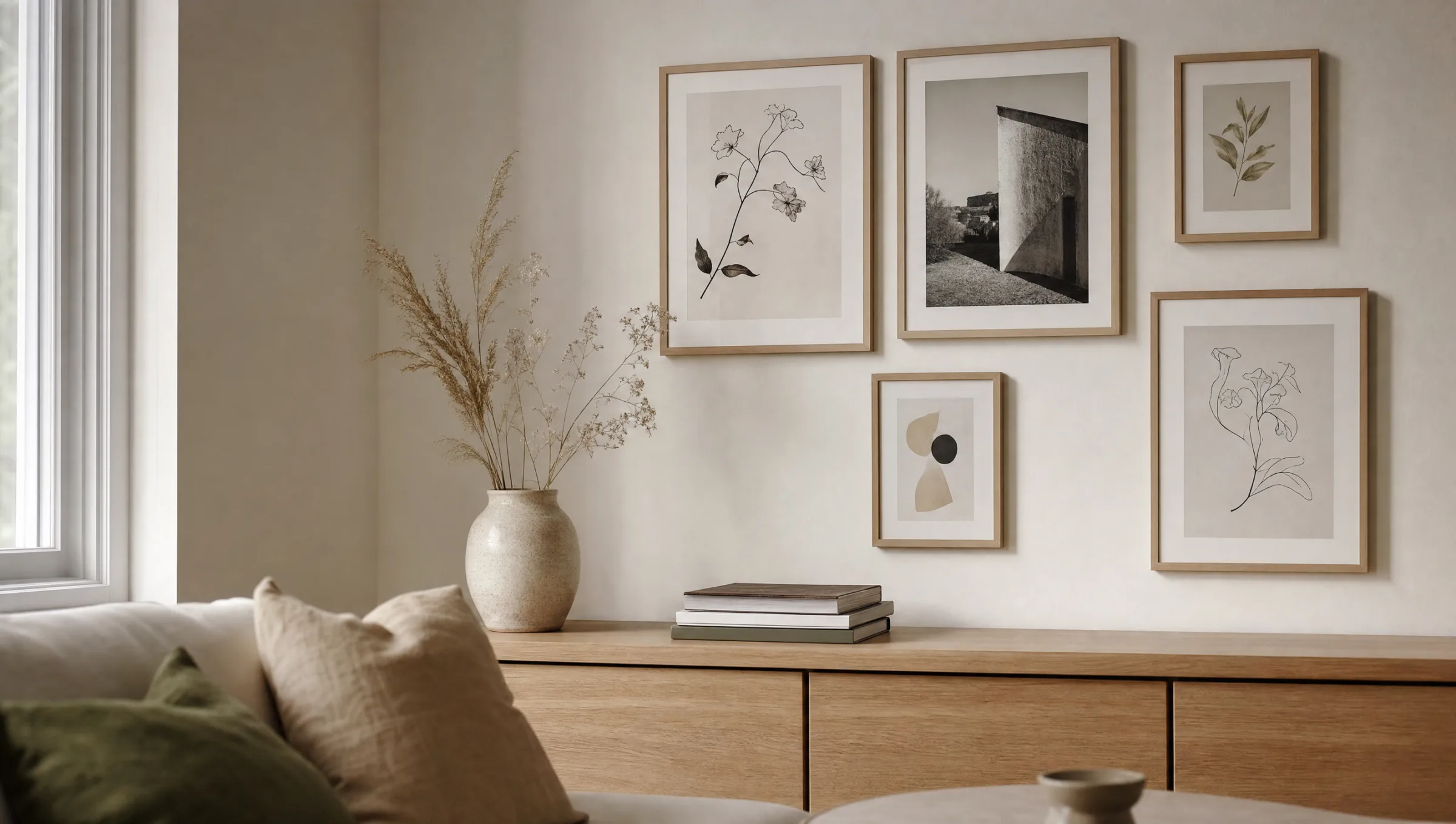
A well-considered combination of motifs often reads as more refined than a single expensive print. Botanical illustrations, black-and-white photographs and abstract line drawings can be arranged into a gallery wall across different formats. What ties them together is a shared colour temperature or a recurring graphic element that gives the series visual coherence.
For those new to wall arrangement, curated sets of two or three coordinated motifs are a practical starting point. They remove the guesswork around sizes and proportions and reduce the risk of a disjointed result. Individual motifs can be swapped out later without disrupting the overall composition.
Care and longevity
Even modestly priced prints can last decades if kept out of direct sunlight and stored in dry indoor air. UV radiation causes colours to fade over time, and high humidity can warp paper. A position with indirect light and a stable room climate significantly extends the lifespan of any print.
Dust can be removed with a soft, dry cloth. Cleaning products should be avoided, as they can react with pigment inks. For framed works, acrylic glazing keeps dust out and provides protection against accidental knocks.
Häufige Fragen
-
01
Where can I buy affordable wall art without compromising on quality?
When looking for affordable wall art, focus on three factors: paper weight of at least 200 g/m², pigment-based print inks, and standard formats such as 30×40 or 50×70 cm. This combination keeps costs low without the result looking cheap. Suppliers who state their printing method and paper type clearly tend to be the better choice. Skipping a pre-fitted frame also helps – a matching frame from a furniture or home store is usually considerably less expensive than a ready-framed print.
-
02
What is the most affordable type of wall art for home display?
Posters on matte fine-art paper are the most accessible option by price. Depending on format, they range from a few pounds for A4 up to the mid-double figures for 70×100 cm. Canvas prints and aluminium panels cost more but arrive ready to hang. For a first wall arrangement, posters are usually the most practical choice, as several motifs can be combined without significant effort or expense.
-
03
Is an affordable wall art set better value than individual prints?
Sets are generally more cost-effective than individually purchased motifs, because production and shipping are consolidated. Pre-configured sets also remove the coordination work – colours, formats and visual language are already matched. For those starting out, this is a pragmatic solution. Anyone wanting a highly individual wall arrangement may prefer to select single prints with more deliberate intent.
-
04
What should I pay attention to when buying affordable wall art?
The key factors are paper weight, printing method and the actual format. Very low prices often come with paper below 170 g/m² that warps easily. Look for stated colour-fastness ratings and realistic product photography. A clearly specified size in centimetres and a named material are good indicators of a fair price-to-quality ratio. At Reetro, even entry-level prints are produced to order by a production partner in the EU on matte fine-art papers from 200 g/m².
-
05
How do I hang affordable posters without an expensive frame?
Wooden or metal poster rails are a simple, low-cost alternative to a traditional picture frame. They grip the poster at the top and bottom, leave the sides open, and have a quietly understated look. Magnetic strips or narrow aluminium rails are equally popular. For those who do prefer frames, standard-format models are available at modest prices and tend to look considerably more considered than their price tag might suggest.
-
06
Does affordable automatically mean poor print quality?
Not at all. Print costs have fallen noticeably in recent years, meaning budget-conscious suppliers can also work with pigment-based inks and FSC-certified papers. At Reetro, posters and wall art are produced to order by a production partner in the EU on matte fine-art papers from 200 g/m² – including in the entry-level range. What matters most is that material specifications are communicated transparently, so the price makes sense in context.