
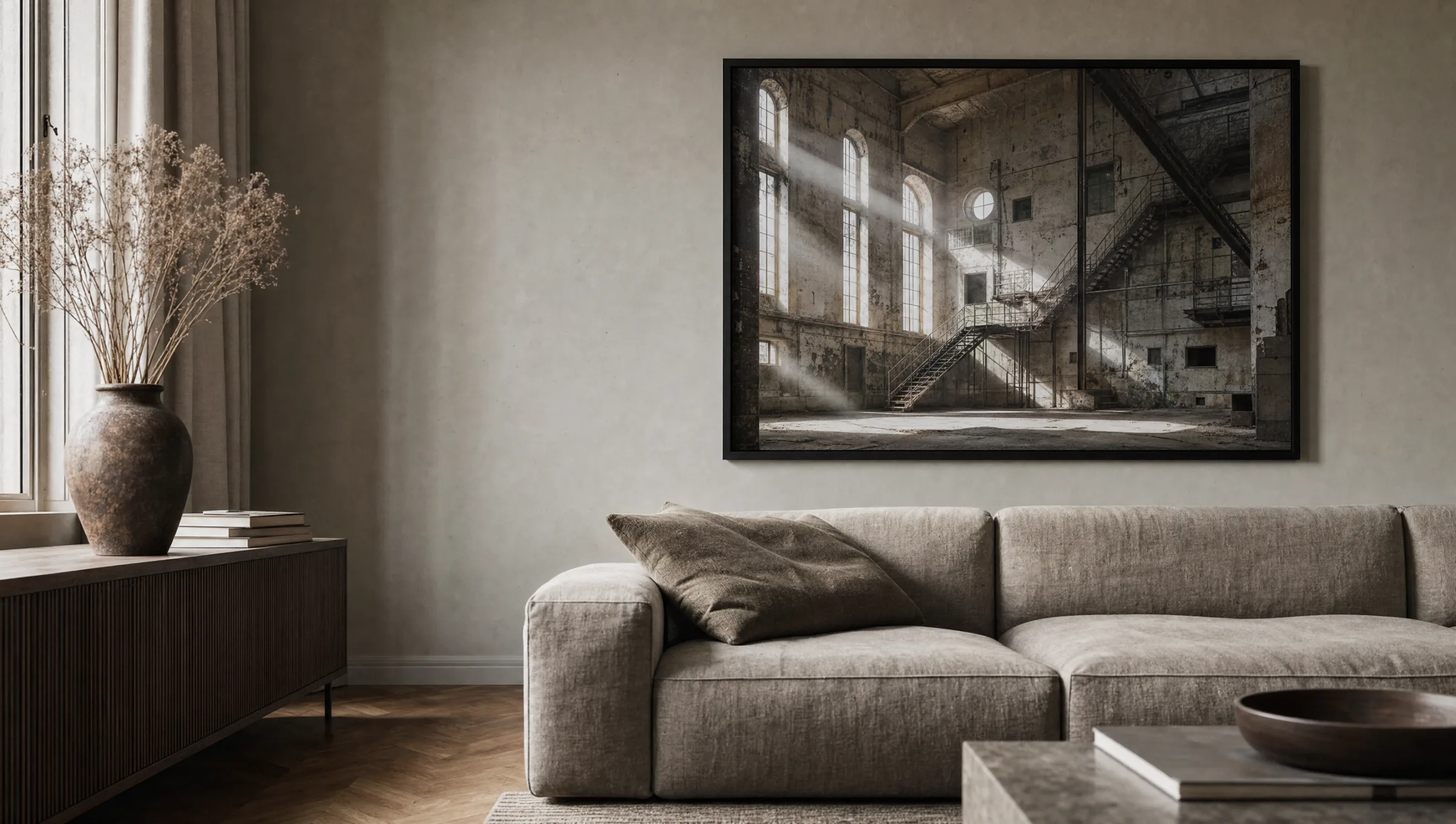
Abandoned Places Photography: The Quiet Allure of the Forgotten on Your Wall
Deserted factory halls, empty sanatoria, overgrown railway stations: abandoned places photography captures the silent beauty of forgotten spaces. This overview categorises the main motif groups, explains suitable print materials, and offers editorial guidance on how to hang prints of neglected architecture in living rooms and workspaces.
What Defines Abandoned Places Photography as a Motif Genre
The term 'abandoned place' refers to a site that has been given up and is no longer in use: decommissioned industrial plants, empty hospitals, deserted hotels, old railway depots, or entire ghost villages. The photographic engagement with such spaces has developed over the past two decades into a distinct genre positioned between documentary and architectural photography.
What characterises abandoned places photography is the tension between decay and composition. Peeling paint, collapsed ceilings, and overgrown stairwells are not caught incidentally but framed with intention — typically using central-perspective symmetry, calm light, and a high level of detail. The images speak less of individual people than of time itself.
In a domestic setting, the genre works well precisely because it feels quiet. Unlike bold pop-art motifs, abandoned spaces bring a contemplative note to an interior — comparable to classic black-and-white photography, but with a stronger narrative undertow.
Typical Motif Groups in Abandoned Places Photography
Abandoned places can be grouped into four recurring motif categories. Each carries its own mood and suits different rooms in the home.
Industry and Factories
Blast furnaces, turbine halls, conveyor belts: industrial motifs draw on clean lines, steel beams, and vast spatial perspectives. They work well in minimally furnished home offices and loft spaces.
Sacred Buildings and Theatres
Abandoned churches, opera houses, and ballrooms reveal stucco, arched ceilings, and faded colour. These motifs often feel almost painterly in living rooms and dining rooms.
Nature Reclaiming Architecture
Plants pushing through window frames, moss on tiles, trees rooted in inner courtyards — such images bridge abandoned places photography with botanical photography.
Transport and Infrastructure
Disused railway stations, rusting trains, or deserted airport terminals speak of the end of entire infrastructures and lend themselves to large-format display in hallways.
Materials and Formats for Abandoned Places Photography
The choice of material has a decisive influence on how a motif reads in a room. Abandoned places photography relies on subtle tonal gradations in dark areas — in shadows beneath collapsed roof trusses or along deep corridors. Matte-coated papers of 200 g/m² or heavier reproduce these gradations calmly and avoid the reflections that gloss finishes would introduce, disrupting the mood.
Premium canvas is particularly well suited when a motif has painterly qualities — for instance, interiors with baroque plasterwork. The fine fabric absorbs light more softly and reinforces the impression of a still painting. For stripped-down industrial shots with hard black-and-white contrast, a hexagonal aluminium wall print is worth considering: the geometric form gently offsets the severity of the architecture.
A straightforward rule applies to format: the further the spatial recession in the image, the larger it should be printed. XXL posters from 70 × 100 cm give elongated perspectives the room they need. Smaller formats can quickly feel cluttered when the motif is rich in detail.
Abandoned places photography works in a domestic setting because it does not want to decorate — it wants to ask a question: who was here, and why did no one come back?
Reetro Editorial
Hanging and Combining Prints in a Living Space
A single large motif generally reads more powerfully than a fragmented gallery wall. Anyone wishing to combine several abandoned places photography prints should keep a consistent colour mood: either entirely black and white, or a restrained palette of earth, rust, and muted green tones. Mixed approaches quickly create visual restlessness.
For hanging, a centre-line at roughly 145 to 150 cm from the floor is recommended — the standard used in most museums. Above sofas or sideboards the print may sit closer to the furniture edge, but it should cover approximately two-thirds of the furniture's width so it does not look adrift.
In terms of interior pairing, the genre sits well alongside reduced, natural materials: oak wood, linen, concrete, brushed steel. Bold colours in the furniture compete with the quiet visual language of the prints.
Legal and Ethical Considerations around Abandoned Places Photography
Although the sites depicted in abandoned places photography often appear open and unclaimed, property rights and trespass laws apply. Reputable photographers work with permission or document locations that are officially accessible. Buyers of prints can assume that curated editions come from verified sources, printed to order by our production partner in the EU to consistent quality standards.
Ethically, it is also considered responsible practice not to publicise exact locations. Many abandoned sites have been damaged or looted in recent years as a result of geotagging. For this reason, image titles in serious editions tend to remain deliberately vague.
Häufige Fragen
-
01
What exactly is abandoned places photography?
Abandoned places photography refers to images of sites that have been given up and are no longer in use: decommissioned factories, empty hospitals, old railway stations, deserted hotels, or entire ghost villages. The photographs combine architectural and documentary photography, working frequently with symmetry, calm light, and a high level of detail. Unlike pure reportage, the aesthetic impression of decay takes centre stage.
-
02
Which material is best suited for abandoned places photography prints?
Matte papers of 200 g/m² or heavier reproduce the subtle tonal gradations in dark image areas calmly and avoid distracting reflections. Premium canvas suits painterly interiors with plasterwork or baroque elements particularly well. For reduced, high-contrast industrial motifs, an aluminium wall print is a sound option, as it renders clean lines crisply. Gloss surfaces tend to feel too harsh for this genre.
-
03
How large should abandoned places photography prints be?
As a general rule: the further the spatial recession in the motif, the larger the format should be. Long corridors, halls, and stairwells only fully unfold from around 70 × 100 cm. Detail-rich close-ups — weathered wallpaper or isolated objects, for instance — also work well at 50 × 70 cm. Above sofas or sideboards, the print should cover roughly two-thirds of the furniture's width so it does not look lost.
-
04
Does abandoned places photography suit every interior style?
The genre harmonises especially well with reduced, natural interiors: oak wood, linen, concrete, brushed steel, and muted tones. In very colourful or playful rooms, abandoned places photography can feel at odds with the surrounding décor. If in doubt, start with a black-and-white motif — it integrates almost anywhere and brings a quiet, contemplative tone to the room.
-
05
Are abandoned places photography prints legal to own as wall art?
For buyers of curated prints, generally yes. What matters is that the photographs come from verified sources and were taken with the necessary permissions. Reputable editions also refrain from naming specific locations, to protect the buildings from vandalism. Anyone wishing to photograph such sites themselves must observe property and trespass laws — entering without permission can constitute a criminal offence.
-
06
Where do the abandoned places photography prints in the Reetro range come from?
Reetro works editorially with selected photographers who document their subjects with permission. Printing is carried out to order by our production partner in the EU on FSC-certified papers of 200 g/m² or heavier with a matte coating, or alternatively on premium canvas or as hexagonal aluminium wall prints. This preserves the tonal range and detail depth of the original photographs without any surface reflection.