
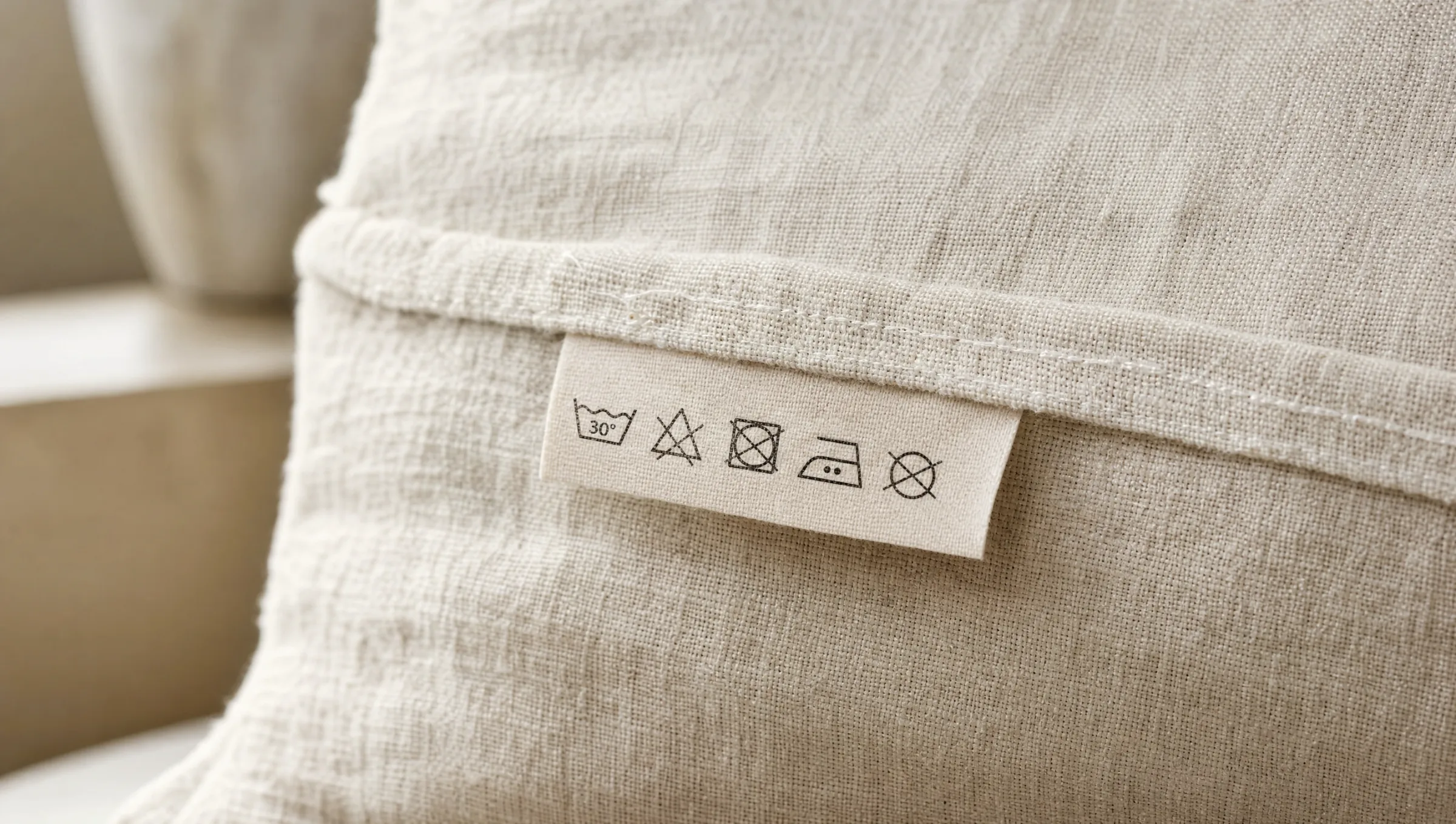
Laundry Care Symbols: A Clear Guide to Their Meaning
Laundry care symbols appear on every label — from bed linen to designer cushions. Yet these small pictograms are often difficult to interpret. This editorial overview explains what each symbol stands for, which care instructions it conveys, and how following them helps home textiles stay looking good for longer.
Why Laundry Care Symbols Matter
Care symbols — commonly referred to as laundry care symbols — are internationally standardised and have followed the GINETEX care labelling system for decades. They are not a mere formality but a concise guide to treating a textile correctly, covering water temperature, spin cycles, bleaching agents, and ironing.
For high-quality materials such as linen, velvet, or printed cotton, correct care is what determines whether colours stay rich or whether a piece looks washed out after just a few laundry cycles. Once you understand the symbols, every care decision takes only a few seconds.
The five core symbols — washing, bleaching, drying, ironing, and professional cleaning — form the basic framework. Within each category, dots, numbers, and lines provide additional guidance on permitted temperatures or the degree of care required.
The Five Key Laundry Care Symbols in Detail
This overview covers the five main groups of laundry care symbols as they appear on almost all European textile labels.
Washtub
The washtub symbol indicates the maximum wash temperature. The number inside the tub (e.g. 30, 40, 60) refers to degrees Celsius. One line beneath the tub means a gentle cycle; two lines indicate an extra-gentle cycle.
Triangle (Bleaching)
An empty triangle permits any bleaching agent. Two diagonal lines inside the triangle allow oxygen-based bleach only. A crossed-out triangle means bleaching is not permitted under any circumstances.
Square with Circle (Tumble Dryer)
Dots inside the circle indicate the dryer temperature: one dot for low heat, two for normal heat. A crossed-out symbol means the item is not suitable for a tumble dryer — air drying is recommended instead.
Iron
Dots on the iron indicate the maximum temperature: one dot for up to 110 °C, two for 150 °C, three for 200 °C. A crossed-out iron symbol means ironing is completely prohibited.
Reading Laundry Care Symbols on Home Textiles
In the home, laundry care symbols are most commonly found on cushion covers, throws, curtains, and table linen. Unlike clothing, these items tend to be larger, heavier, and washed less frequently — which makes choosing the right temperature on the first wash all the more important.
Printed textiles, such as designer cushions with elaborate sublimation or pigment prints, typically require a gentle cycle at 30 °C without bleach. The washtub symbol with a single line beneath it is the reliable indicator here. Ignoring these instructions risks fading of colour areas or the breaking down of fine lines in the print.
Natural fibres such as linen, on the other hand, often tolerate 40 °C without a gentle programme. The material handles mechanical stress well but should ideally be air-dried to preserve its characteristic texture.
Reading laundry care symbols like a short set of instructions can add years to the life of a textile.
Reetro Editorial
Common Misconceptions About Laundry Care Symbols
A widespread misunderstanding: people assume the temperature shown is the recommended wash temperature. In fact, it is the maximum permitted temperature. Washing at a lower temperature is almost always possible and is gentler on both the material and the colour.
The circle as a standalone symbol is also often misread. It does not refer to the tumble dryer but to professional dry cleaning. Letters inside the circle — P, F, or W — inform dry cleaners about the permitted solvents and are rarely relevant to the end consumer.
Finally, a crossed-out symbol is always an unambiguous prohibition. An empty washtub without a number, by contrast, means that hand washing or machine washing is generally permitted, but no specific temperature is stated.
Laundry Care Symbols and Material Quality
High-quality fabrics are generally labelled with conservative care instructions because manufacturers want to ensure the longevity of their products. A 30 °C symbol with a gentle-cycle line does not necessarily mean the textile is delicate — it often reflects the manufacturer's intention to allow the item to last as long as possible.
For premium-segment home textiles, it is also worth avoiding fabric softener. Softeners can coat fibre structures and alter the appearance of printed surfaces — a detail that laundry care symbols do not address directly, but one that matters for printed pieces made to a high standard by our production partner in the EU.
Häufige Fragen
-
01
What do laundry care symbols on textile labels mean?
Laundry care symbols are standardised pictograms that explain how a textile may be treated. They cover five main areas: washing, bleaching, drying, ironing, and professional cleaning. Each symbol indicates the maximum permitted temperature or the required level of care. Reading them correctly helps avoid damage from excessively hot washes, the wrong bleaching agent, or unsuitable dryer programmes, and significantly extends the life of clothing and home textiles.
-
02
Which laundry care symbols indicate the correct wash temperature?
Wash temperature is shown by the washtub symbol with a number inside it. Common values are 30, 40, 60, and 95 degrees Celsius. One line beneath the tub means a gentle cycle; two lines indicate an extra-gentle programme, typically used for wool or delicate fabrics. A hand inside the tub means hand wash only at a maximum of 30 °C. A crossed-out washtub means all forms of wet washing are prohibited.
-
03
What does a circle mean as a laundry care symbol?
A standalone circle refers to professional dry cleaning. Letters inside the circle — usually P, F, or W — indicate the permitted solvents and are primarily relevant to professional cleaning services rather than to the consumer at home. An empty circle permits all common dry-cleaning methods; a crossed-out circle prohibits dry cleaning entirely. Confusion with the tumble-dryer symbol is common, as the dryer is represented by a circle inside a square.
-
04
Are laundry care symbols the same in every country?
Within Europe, the symbols are regulated uniformly under the GINETEX standard and are trademark-protected in many countries. ISO 3758 largely aligns with this system as well. Differences exist mainly in the United States and Japan, where additional symbols or written instructions may be used. For textiles made in Germany, the European laundry care symbols apply, and their meanings are as described in this overview.
-
05
How should I care for printed home textiles according to laundry care symbols?
Printed cushion covers and similar home textiles are typically labelled for a gentle cycle at 30 °C, without bleach and without tumble drying. It is also advisable to avoid fabric softener and to turn the fabric inside out before washing, in order to protect the printed surface. At Reetro, designer cushions are printed to order by our production partner in the EU and labelled with clear care instructions, so that the colour intensity of the prints is preserved through many washes.