
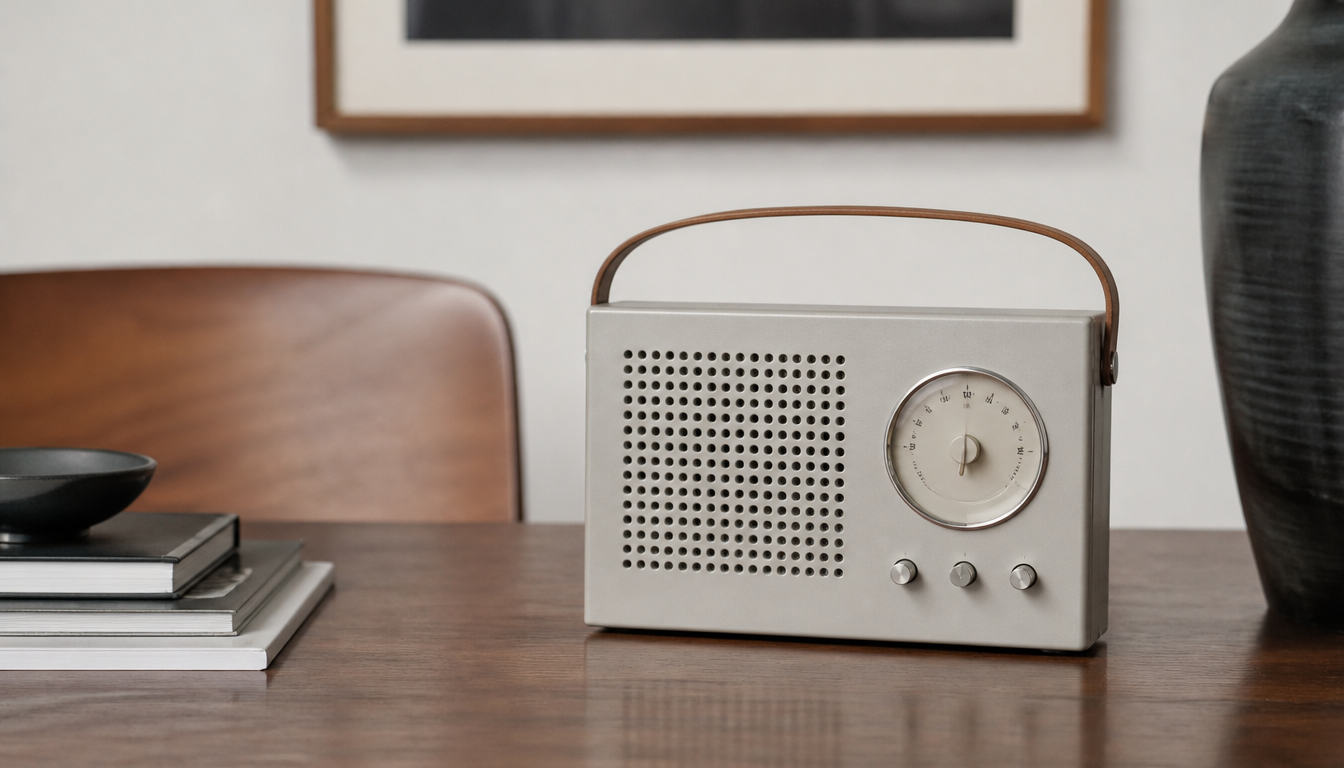
In 1958, Braun introduced the T3 transistor radio, designed by Dieter Rams as one of Germany’s first consistently minimalist pocket radios, shaping the design language of portable electronics for decades to come. The T3 was no ordinary gadget of its time: with its reduced perforated grille surface, clean type panel, and the absence of any decorative detail, Rams demonstrated that function and aesthetics are not opposites. Anyone holding an iPhone or a modern Bluetooth speaker today can still feel that influence. For sneaker and design fans who take vintage culture seriously, the T3 is exactly that: an original that needed no copy.
Braun T3 (1958): How a Small Radio Changed Product Design Forever
The Braun T3 transistor radio from 1958 is considered one of the most influential industrial design objects of the 20th century. Designed by Dieter Rams, it set a radical counterpoint to the ornamental design language of its time: no superfluous lines, no decorative elements, only the bare essentials. That was precisely the revolution.
Less is more, even on the shelf
The T3 was Braun’s first truly portable pocket radio. It literally fit in a shirt pocket, weighed almost nothing, and was fully functional nonetheless. Rams followed a principle he would later articulate as “Good design is as little design as possible.” The T3 made that statement tangible long before he ever wrote it down.
What this means for you:
-
Timelessness beats trends. The T3 doesn’t look dated today — it looks simple. Objects that embrace reduction age more slowly. This applies to electronics just as much as to wall décor. Anyone furnishing their space with clean forms is making a lasting choice — for example with a Bauhaus poster or the Bauhaus Hexagon wall art on the wall.
-
Function defines form. Rams designed the T3’s controls and housing so that operation was intuitive — no manual required. This thinking is also found in good home design: a mouse pad that is both ergonomic and visually coherent fulfils both demands at once, just like the Kandinsky mouse pad with abstract forms.
-
Minimalism is not deprivation. The T3 had everything it needed and nothing beyond that. Anyone wanting to apply this principle to their living space should reach for décor that makes a clear statement. A Bauhaus-style decorative cushion or an abstract retro cushion sets exactly this accent without overwhelming.
-
Originals inspire new things. The T3 directly influenced the design of the first iPhone, as Jonathan Ive confirmed publicly on multiple occasions. Vintage objects are therefore not nostalgia — they are precursors. Anyone who appreciates design history will find a curated selection of posters, wall art, and accessories in the reetro shop that continues precisely this lineage.
The historical context
In 1958, Dieter Rams was not yet 30 years old and had been working at Braun for only a few years. The company from Kronberg im Taunus had just decided to move away from the Ulm design approach that had dominated German industrial aesthetics up to that point. Rams and his team created with the T3 a device that set new standards in its flatness and clarity. The cream-coloured plastic housing, the precisely placed perforated-grille speakers, and the unadorned slider controls became hallmarks of an entire design philosophy.
The T3 was no isolated case, but a prelude: in the years that followed, Rams developed dozens of further products for Braun, all breathing the same principle. The “Ten Theses for Good Design” that he later wrote read like an instruction manual for the T3.
For anyone looking for wall décor that conveys this spirit: the Bauhaus advertising poster of the art school and the Kandinsky poster in yellow-blue-red fit stylistically right into this era. And for those who prefer something a little more playful, the MCM aluminium hexagon wall décor offers a beautiful bridge between Mid-Century Modern and contemporary interior style.
Sources
- YouTube: Braun T3 Video
- LinkedIn: AJ Braun, Founder CEO apii
- LinkedIn: Speeding Up Incremental Data Loads into Delta Lake using File Metadata
FAQ
What makes the Braun T3 from 1958 so special?
The Braun T3 is considered one of the first consistently minimalist transistor radios ever designed. Dieter Rams created it with clean lines, a plain housing, and an operating logic that tolerated nothing superfluous. No frills, no ornamentation — only the essentials. That was nothing short of a small revolution in portable broadcasting in 1958.
Who is behind the design of the Braun T3?
Dieter Rams, then still a young member of the design team at Braun, was primarily responsible for the T3’s design language. His approach: less, but better. The T3 thus became an early proof of his later famous ten principles of good design. With devices like these, Rams shaped an entire generation of designers.
Was the Braun T3 genuinely portable, or was that just a marketing promise?
Genuinely portable. The T3 ran on batteries and was compact enough to carry around. At the time, transistor radios were replacing bulky valve sets and made mobile radio reception practical for a broad public for the first time. The T3 represented the premium, design-conscious variant of this new format.
What influence did the Braun T3 have on later product design?
The influence can hardly be overstated. The T3’s reduced aesthetic is widely regarded as a direct predecessor for generations of consumer devices. The line to Apple’s iPod and early iPhone designs is drawn most frequently. Jony Ive, Apple’s long-serving chief designer, publicly acknowledged the influence of Rams and Braun on multiple occasions.
Is the Braun T3 still available today, and is buying one worthwhile for collectors?
Yes, the T3 still surfaces at flea markets, in vintage shops, and with specialist online dealers. For design history enthusiasts and collectors, it is a genuine piece of cultural heritage. Condition varies considerably, of course, so choose carefully. A well-preserved example is more than a radio — it is a document of design history.
This article was generated automatically by an AI system. Disclosure pursuant to Article 50 of the EU AI Act.